

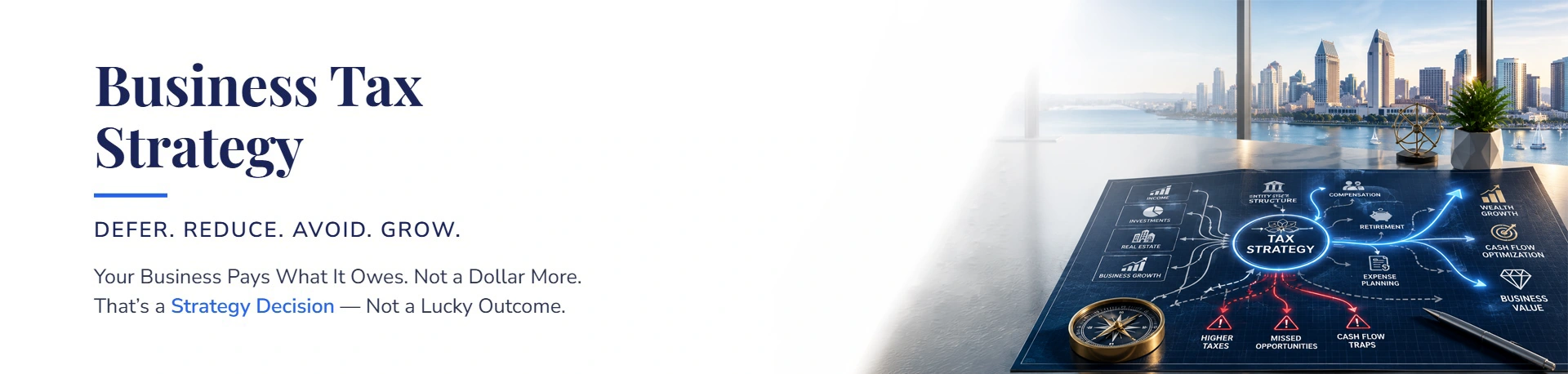

Your Business Pays What It Owes. Not a Dollar More. That's a Strategy Decision, Not a Lucky Outcome.
Every year, businesses across San Diego write larger tax checks than they have to. Not because of bad intentions, but because of absent planning. The decisions that determine your annual tax liability aren’t made in April. They’re made throughout the year, in the moment, and without a tax lens in place. By the time your return is filed, those decisions are locked in.
Our business tax strategy services in San Diego which are built on avoidance, deferral, and reduction, are designed to change that equation, for small business owners, growing companies, and established corporations that are ready to treat their tax position as a strategic asset rather than an unavoidable cost. See how this integrates with our business tax preparation and Fractional CFO services for a fully coordinated financial practice.
The Moment Most Business Owners Realize They Have a Tax Problem
We hear versions of the same story from business owners across San Diego every week:
- “We had a great year, I just didn’t realize how much of it I’d owe.”
- “We bought equipment in January. If we’d waited until December, would that have changed things?”
- “Our entity structure made sense when we started. Is it still right for where we are now?”
- “We distributed profits to the owners at year-end. Was that the most tax-efficient way to do it?”
- “We’re growing fast. Nobody has told us what that means for our tax exposure next year.”
These aren’t questions without answers, they’re questions that needed to be asked earlier; our job is to make sure they are.

As a Business Owner, Are You Proactive or Reactive With Your Taxes?
Are you reacting to everything every single year or are you planning a year, or multiple years in advance? Most business owners are reactive. They call their tax professional in March, find out what they owe, and write the check. The planning window closed months, or even years ago.
Here’s what that costs: a business owner who sells a piece of equipment in January, distributes profits in December, and hires two employees mid-year without a tax advisor involved in any of those decisions, often pays tens of thousands more than they needed to. Not because the decisions were wrong. Because nobody modeled the tax consequences before they were made.
The most impactful thing we do for business clients isn’t prepare their return. It’s being in the conversation before the decisions are locked in. Q4 is the most powerful planning window of the year, but only if you’re already engaged.

What Business Tax Deferral & Strategy Actually Means
These aren’t loopholes. They’re fundamental features of the tax code, built in deliberately for businesses that plan ahead. Tax avoidance is the legal use of the code to minimize what your business owes, claiming every deduction, credit, and structural advantage you’re entitled to within the rules as written. Tax deferral is a specific form of avoidance, allowing taxpayers to legally delay the recognition of taxable income, or accelerating deductible expenses to reduce your current-year burden and improve cash flow. It doesn’t eliminate tax; it creates time and flexibility to manage it more intelligently. Tax reduction covers strategies that permanently lower your liability such as entity elections, compensation structuring, and deduction optimization. None of this is tax evasion, which is illegal. Everything we do falls under the first three and are fully compliant, properly documented, and defensible.
Done right, these three levers are some of the most powerful financial tools available to a business owner. Here’s what they look like across the disciplines we manage:
Entity Structure & Classification
The legal form of your business, sole proprietorship, LLC, S-Corp, C-Corp, or partnership, has a direct and substantial impact on how your income is taxed. An S-Corp election alone can save a profitable business owner tens of thousands of dollars per year in self-employment tax. We evaluate your entity structure as part of every engagement and make recommendations based on your actual numbers.
Depreciation Acceleration & Cost Segregation
Under current tax law, businesses can elect to immediately expense many capital investments through Section 179 expensing and bonus depreciation. For real estate, cost segregation studies can dramatically accelerate deductions. These provisions are time-sensitive and require deliberate planning to optimize.
Retirement Plans as Tax Shelters
A SEP-IRA can shelter up to 25% of net self-employment income. A solo 401(k) allows for both employee and employer contributions. A defined benefit plan can allow high-earning business owners to defer well over $100,000 per year from current taxation. We analyze your cash flow and profitability to identify which plan structure delivers the most deferral with the least administrative burden.
Income & Expense Timing
For cash-basis businesses, when income is received and expenses are paid is a controllable variable. Accelerating deductible expenses into the current year or deferring billable income into the next can shift meaningful dollars between tax years.
Owner Compensation & Distribution Strategy
For S-Corp and C-Corp owners, the mix of salary, distributions, dividends, and fringe benefits is one of the highest-impact tax decisions made each year. Pay too much in salary and you’re overexposed to payroll taxes. Pay too little and you risk IRS scrutiny. We model the optimal compensation package for every annual planning engagement.
Qualified Business Income (QBI) Deduction Optimization
Pass-through business owners may be eligible for the 20% QBI deduction under Section 199A, which is one of the most significant tax benefits introduced in recent years. But eligibility, phase-outs, and limitations are complex. We analyze your QBI position and structure compensation, wages, and entity decisions to maximize what you qualify for.

Small business owners and self-employed professionals
who want to stop overpaying and start making informed decisions about how their business income is structured and taxed.

Growing companies between $500K and $10M in revenue
that have outgrown basic compliance and need a proactive tax partner who thinks about their future, not just their past.

S-Corp and LLC owners
who want to ensure their entity structure, compensation strategy, and distribution approach are optimized for their current stage of growth.

Multi-entity businesses
where income flows across multiple related structures and needs to be managed for efficiency at the consolidated level.

Business owners planning for a future sale or exit
who need to understand the tax consequences of different deal structures well in advance of any transaction.

Dentists and dental practices
managing entity structure, equipment depreciation, and the tax implications of practice ownership or a future Dental Service Organization (DSO) transition.

Medical doctors and physician practices
navigating the tax complexity of clinical entities, partnership structures, and practice-level compensation planning.

Pharmacists and pharmacy owners
balancing inventory accounting, retail tax treatment, and the entity decisions that affect reimbursement-driven margins.

Veterinarians and veterinary practices
structuring ownership, equipment purchases, and multi-location tax planning as their practices scale.

Engineers and engineering firms
optimizing entity structure and depreciation strategy around project-based income and capital equipment.

Information technology companies and MSPs
managing recurring revenue recognition, R&D credit eligibility, and entity structuring for scalable growth.

Real estate investors and landlords
building strategy around depreciation, cost segregation, 1031 exchanges, and passive activity rules across property portfolios.

Real estate agents, brokers, and teams
managing the tax timing complexity of commission-based, irregular income.

Construction companies and general contractors
structuring entity elections, equipment depreciation, and job-cost-driven tax planning across multiple active projects.

HVAC companies
building strategy around depreciation, cost segregation, 1031 exchanges, and passive activity rules across property portfolios.

Plumbers
managing the tax timing complexity of commission-based, irregular income.

Electricians and electrical contractors
structuring entity elections, equipment depreciation, and job-cost-driven tax planning across multiple active projects.

Garage door companies
balancing installation versus recurring maintenance revenue for tax-efficient planning.

Roofing contractors
managing the tax timing of project-based revenue against material cost volatility and seasonal demand cycles.
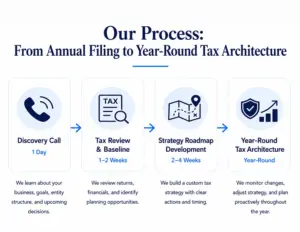
Our Process: From Annual Filing to Year-Round Tax Architecture
Step 1: Discovery Call (1 Day)
A free, focused conversation to understand your entity structure, compensation arrangements, prior year tax position, and where your biggest planning opportunities are. We ask the questions most tax preparers skip: What does your business look like in three years? Are you planning an exit? What decisions are you making this year that have tax consequences?
Step 2: Tax Review & Baseline (1–2 Weeks)
We review your recent returns, entity structure, and current financial position. This gives us the full picture of where you are, and a clear sense of where the most significant opportunities lie. Most businesses are surprised by what we find.
Step 3: Strategy Roadmap Development (2–4 Weeks)
We build a current-year tax projection based on your actual financials and expected year-end trajectory. We identify every available deferral, deduction, and structural opportunity, and deliver a written roadmap with specific recommendations and timing.
Step 4: Year-Round Tax Architecture
From here, we stay in contact throughout the year via quarterly check-ins, real-time input on major decisions, and a year-end planning sprint before December 31st. At filing time, your return reflects a year of deliberate decisions, not a scramble. And the moment it’s filed, we’re already planning next year.
Business Tax Strategy in California: The Added Complexity
California presents a uniquely challenging environment for business taxation, and one where good planning pays dividends far beyond what most states offer. Treating federal and California tax strategy as separate is how planning errors happen; we manage both layers simultaneously.
- California does not conform to many federal provisions. Bonus depreciation, for example, is disallowed in California, meaning a business that accelerates deductions federally still faces the full depreciation schedule at the state level.
- The FTB is assertive. California is aggressive in both enforcement and audit selection, particularly for businesses with high pass-through income, owner compensation, or deductions that diverge significantly from prior years.
- Minimum franchise tax and gross receipts rules create obligations that apply regardless of profitability, thus affecting entity structure recommendations for new and early-stage businesses.
- Employment taxes and payroll compliance are heavily regulated in California with the EDD actively auditing worker classification and payroll tax accuracy.
Business Tax Strategy & Deferral Services We Provide
 Entity structure review and election analysis
LLC, S-Corp, C-Corp, Partnership: We evaluate whether your current legal structure still fits your income and growth stage, and model what changing it would actually save.
 Owner compensation and reasonable salary analysis
We find the salary-to-distribution split that limits payroll tax exposure without inviting IRS scrutiny.
 Retirement plan design and contribution optimization
SEP, Solo 401(k), defined benefit: We identify which plan shelters the most income given your cash flow, profitability, and tolerance for administrative overhead.
 Depreciation strategy
Section 179, bonus depreciation, cost segregation: We time capital purchases and structure depreciation elections so equipment and property deductions land in the years they’re worth the most.
 Income and expense timing for cash-basis businesses
We strategize the timing of income and expenses across tax years, so the calendar works in your favor instead of against you.
 Multi-year tax projections and scenario modeling
We model the tax consequences of major decisions before you commit to them, across several years rather than just the one in front of you.
 Business real estate tax planning
1031 exchanges, passive losses, depreciation recapture: We structure how property is held and sold around exchange eligibility, passive activity limits, and recapture exposure.
 Federal and California state tax strategy coordination
We plan both layers together, so a federal move like bonus depreciation doesn’t produce an unwelcome surprise on the California return.
 Qualified Business Income (QBI / Section 199A) deduction optimization
We analyze your eligibility and structure wages, entity choice, and compensation to capture as much of the 20% deduction as the phase-outs allow.
 Distribution strategy and dividend planning for C-Corps
We plan how and when profits leave the corporation to limit double taxation on owner distributions.
 Intercompany transaction planning for multi-entity structures
We coordinate how income, expenses, and transfers move between related entities so the consolidated position is both efficient and defensible.
 Quarterly estimated tax planning and cash flow alignment
We size and schedule your estimated payments against real cash flow, so you avoid penalties without parking extra money with the IRS all year.
 Exit and transition tax planning
Deal structure analysis, installment sales, earnouts: We compare deal structures years ahead of a sale so after-tax proceeds, not just the headline price, drive the decision.
Why Business Owners Choose Gildark Financial
We Think Like a CFO, Not Just a Tax Preparer.
Business tax strategy doesn’t exist in isolation. It intersects with your cash flow, your growth plans, your ownership structure, and your exit timeline. Because we also offer Fractional CFO services, we bring that broader financial lens to every tax engagement.
We Work Across the Full Tax Year.
April is too late. We engage with business clients throughout the year because that’s when tax decisions are actually made. Our proactive model means you’re never discovering avoidable consequences after the fact.
We Handle Both Federal and California.
California’s tax treatment of businesses diverges from federal law in ways that create significant traps for the unprepared. We manage both layers simultaneously and make sure your planning works at every level.
We’re Credentialed to Represent You.
As licensed Enrolled Agents, we can represent your business directly before the IRS and California tax agencies, in audits, appeals, and collection matters. Your strategy is defensible, documented, and backed by professionals who can stand behind it.
No Surprises.
Transparent pricing. Clear communication. A team that tells you what your numbers mean, and in language you can act on.
Call us now
The solutions, insights, and guidance you need to achieve your financial goals are at your fingertips — but you have to make the call. Contact us online or call our office today to explore our full range of services with a knowledgeable financial professional.
Frequently Asked Questions
What’s the most impactful single thing a business can do to reduce its tax bill?
It depends on your entity structure, income level, current-year position, and your specific circumstances. For many business owners, the combination of the right entity election and a properly funded retirement plan delivers the single largest immediate impact. That’s why we start with a review before we make any recommendations.
Can you help a business that has already had a bad tax year?
Yes. We can’t go back and change what’s already locked in, but we can build a strategy starting now that dramatically improves your position going forward.
How does business tax strategy relate to your accounting and bookkeeping services?
Closely. Clean, current books are the foundation of effective tax planning. If your financials are months behind or unreliable, we can’t make accurate projections or time decisions correctly. We often recommend integrating bookkeeping and tax strategy from the start, and we’re set up to deliver both.
When should a business start thinking about exit tax planning?
Years before the exit, ideally three to five. The tax consequences of how a business is sold can vary by hundreds of thousands or millions of dollars. We work with business owners well in advance of any planned transaction to structure the exit for maximum after-tax proceeds.
What’s the difference between tax avoidance, deferral, and evasion for a business?
The same distinction applies to businesses as it does to individuals, and it’s worth being precise about, because the confusion keeps business owners from using strategies they’re fully entitled to.
Tax avoidance is the legal use of the tax code to minimize what your business owes by choosing the right entity structure, claiming every available deduction and credit, and structuring compensation and distributions within the rules as written. This isn’t aggressive or risky. It’s exactly what the code is designed to allow.
Tax deferral is a specific form of avoidance, allowing taxpayers to legally delay when income is recognized or accelerating when expenses are deducted, so your business retains more capital now and manages the tax consequence later, often at a more favorable time.
Tax reduction covers strategies that permanently lower your liability rather than just postponing it; entity elections, retirement plan funding, and QBI optimization are all examples.
Tax evasion is illegal. This includes underreporting income, inflating deductions, or misrepresenting business transactions to the IRS or California tax agencies.
Everything we do at Gildark Financial falls under avoidance, deferral, and reduction. We never engage in evasion, and every strategy we recommend is properly documented and fully defensible if your return is ever examined.

 619-736-3044
 Email Us
 1597 N Johnson Ave, El Cajon CA 92020