

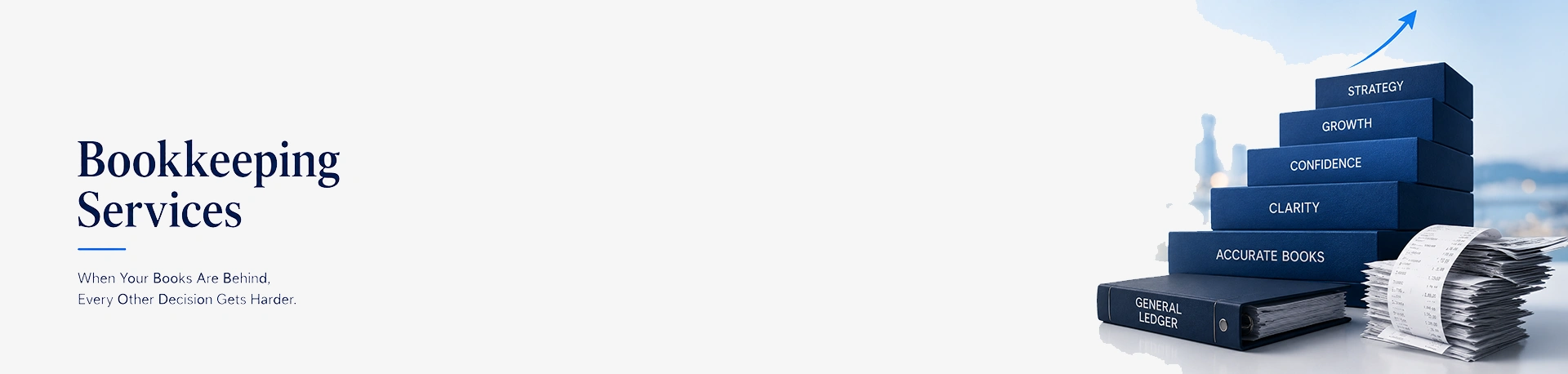

When Your Books Are Behind, Every Other Decision Gets Harder.
Bookkeeping is the foundation of every financial decision you’ll ever make in your business. Hiring someone? You need your numbers. Applying for a loan? The lender needs your books. Filing your taxes? Your accountant needs clean records. Making a major investment? You better know your cash position first. When the foundation is shaky, everything built on top of it is too.
At Gildark Financial Solutions Group, our San Diego bookkeeping services are designed for business owners who are done guessing, done falling behind, and ready for financial records that actually reflect what’s happening in their business in real time. We connect your daily numbers to your long-term decisions, and we do it as part of a fully integrated financial practice. See how our bookkeeping practice connects to our small business accounting services and business tax preparation for a complete financial picture.
Does This Sound Familiar?
We hear versions of the same story every week from business owners across the United States:
- “I have been meaning to clean up my books for months. I just haven’t had time.”
- “I honestly don’t know if we’re profitable right now. I can’t trust the numbers I’m looking at.”
- “The IRS wants documentation and I’m not sure I can produce.”
- “My bookkeeper was a friend and just quit; now I don’t know what state she left things in.”
- “I’ve been doing it myself in QBO but I don’t think it’s right.”
If any of those sound like you, that’s ok. You’re not behind because you don’t care; you’re behind because running a business is a full-time job, and the books are the thing that keeps slipping. That’s exactly why we exist

The Real Cost of Staying Behind on Your San Diego Business Books
The Real Cost of Staying Behind on Your San Diego Business BooksMost business owners know their books aren’t perfect. What they underestimate is how much that imperfection costs them not just at tax time, but every day.
- The owner (or a friend) doing their own bookkeeping. Transactions miscategorized, reconciliations months behind, a P&L that doesn’t match reality. Decisions are being made on numbers that can’t be trusted.
- The business that never set up proper books. Operating for years through personal accounts and spreadsheets or stumbling through it all at year end. When it’s time to file taxes, apply for financing, or bring on a partner, the scramble is expensive and stressful.
- The business that got busy and let things slide. Six months of unreconciled statements. A stack of vendor invoices that were never entered. Payroll run through a separate system that was never synced.
- The owner who got burned by a bad bookkeeper. The prior person was unreliable, inaccurate, or just disappeared. The books now need forensic attention before they’re usable again.
Every one of these situations is fixable. And fixing them sooner is always less expensive than waiting until the problem forces the issue.

As a Business Owner, Are You in the Driver's Seat of Your Finances?
If you were to think of your business as a car, your only goal is to get from where you are today to where you want to be. Who’s behind the wheel? Who’s reading the road? And who’s making sure the record of everywhere you’ve been is accurate enough to be useful?
That last question about what has already happened and why, is the bookkeeper’s job. And it matters far more than most business owners realize until it’s gone.
The Bookkeeper: Eyes on the Rearview Mirror
Bookkeepers look in the rearview mirror. They record historical data, every transaction, every route taken, every left and right turn, the miles per gallon of fuel, the location of stop lights and signs along the way. They capture every dollar in and every dollar out, ensuring that everything is accurately recorded in your company’s financials.
That rearview view isn’t passive; it’s the record that everything else depends on. Without it, your accountant is flying blind. Your tax preparer is guessing. Your CFO can’t navigate from an unknown starting point. The bookkeeper is the one who makes sure the record is true and that your accounting system stays organized.
When a bookkeeper does their job well, you can answer things like where that money went last month, what was actually spent on vendors, whether your expense tracking is accurate, whether your receivables are current, and if your payroll records are correct. These aren’t just trivial questions, they’re the foundation of every financial decision that comes next.
The Accountant: Hands on the Wheel
An accountant is in the driver’s seat. They know where they’re going, how much gas they have, how much air is in the tires, when the last oil change was, how fast they’re allowed to drive on the road, and most importantly how to drive the car. They take the bookkeeper’s accurate record and use clean books to prepare financial statements, support regulatory compliance, shape tax strategy, and provide informed guidance.
The Fractional CFO: Navigation in the Passenger Seat
A Fractional CFO is in the passenger seat with the navigation plotting the course and direction, guiding the driver toward the destination while avoiding roadblocks, adapting to ever-changing road conditions, and watching for sinkholes. While they may not drive the car personally, the CFO shoulders far more responsibility in the overall success of any business.
The bookkeeper makes the whole system work. Without an accurate rearview mirror, the driver can’t know where they’ve been, and the navigator can’t plot a course from an unknown starting point. Great bookkeeping isn’t just a compliance task. It’s the data layer that every other financial function in your business runs on.
What Professional Bookkeeping Services Actually Do for Your Business
Bookkeeping gets described as a compliance necessity, and something you do because the IRS requires it. That framing undersells it dramatically.
Clean, current books are a decision-making tool.
You Always Know Where You Stand.
Real-time visibility into revenue, expenses, accounts receivable, and cash position means you’re never making financial decisions in the dark, which supports stronger financial management and better financial health. Are you profitable this month? Can you afford to hire? What does your cash position look like in 60 days? These questions should have answers you can pull up in minutes, not ones that require a week of reconciliation to find.
Your Tax Preparer Can Do More for You.
When your books arrive clean and current at tax time, your accountant isn’t spending their time cleaning up transactions, they’re spending it to assist with strategy and finding opportunities. Deductions get caught. Timing strategies get considered. At Gildark Financial, bookkeeping and tax preparation happen under the same roof because that coordination is built in, not bolted on.
You Can Actually Get Financing.
Lenders, investors, and key vendors want to see your financials before they extend terms or capital. Sloppy, outdated, or inconsistent books kill deals and slow approvals. Professionally maintained financial statements open doors that disorganized records keep closed.
You’re Protected in an Audit.
If the Internal Revenue Service (IRS), California Franchise Tax Board (FTB), or any other state agency ever questions your returns, your books are your evidence. Properly maintained, reconciled, and categorized records help you stay compliant with local tax laws and other requirements, allowing you to demonstrate compliance quickly and conclusively. Books that can’t be explained are a liability.
You Can Actually Plan.
Budgeting, forecasting, and strategic planning all require a reliable historical baseline. If your P&L isn’t accurate, your projections won’t be either, making it harder to align plans with business goals and support sustainable business growth.
Full-Service Bookkeeping Solutions for Growing Companies
We provide a full range of accounting and bookkeeping services for growing companies in San Diego and across Southern California, built around QuickBooks Online and calibrated to your industry, your complexity, and your growth stage.
Every transaction in your business tells a story. Our team records, reviews, and categorizes transactions monthly so your books stay current, accurate, and meaningful with categorization logic that aligns directly with your tax returns.
Reconciliation is the quality-control step most DIY books skip. Every account gets reconciled monthly, ensuring that what’s in your system matches what actually cleared and that any discrepancies are caught before they compound.
We track what you owe, to whom, and when, giving you visibility into upcoming cash obligations and helping you maintain good vendor relationships through timely, accurate payments.
We monitor outstanding invoices and receivables so you always know what’s owed to you, and aging balances get flagged before they become collection problems. Cash flow starts with collecting what you’ve already earned.
For businesses running payroll through Gusto, ADP, QBO, or another provider, we reconcile payroll entries against your books monthly ensuring labor costs are properly recorded, wage accounts are correct, and payroll tax liabilities are accurately reflected.
Each month, you receive clean, accurate financial statements like the Profit & Loss statement, Balance Sheet, and Cash Flow Statement because these aren’t just compliance documents; they’re the scoreboard you run your business from.
If your QuickBooks was never set up properly, has accumulated errors, or has been neglected, we’ll fix it. Proficiency in cloud-based software like QuickBooks Online or Xero matters here to keep records up-to-date. Our QBO cleanup and catch-up bookkeeping engagements bring your books current, correct historical errors, and establish a clean foundation going forward. We also handle initial QBO setup for businesses starting from scratch.
At year-end, we prepare your books for the filing process while reviewing accounts, making adjustments, and delivering a clean, organized package to your tax preparer. Or we handle preparation ourselves, since both functions live under our roof.
We flag unusual trends, alert you to cash flow concerns, and provide the kind of straightforward financial commentary that helps you run your business with confidence, with ongoing visibility that also gives you access to practical resources. For clients who want deeper financial leadership, our Fractional CFO services build directly on this foundation.
Call us now
The solutions, insights, and guidance you need to achieve your financial goals are at your fingertips — but you have to make the call. Contact us online or call our office today to explore our full range of services with a knowledgeable financial professional.
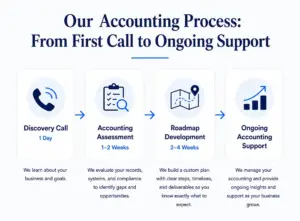
Our Process: From First Call to Clean Books
Getting your books in order shouldn’t feel like starting over in the dark. Here’s exactly how we bring every bookkeeping client on board with full visibility into what happens at each step before we begin.
Step 1: Discovery Call (1 Day)
A focused conversation to understand your current situation, your existing setup (or lack thereof), your biggest pain points, your business needs, and your business size so we can define what “getting this right” actually looks like for your business. No sales pitch. Just an honest assessment of where you are and whether we’re the right fit.
Step 2: Books Assessment (1–2 Weeks)
Once engaged, we conduct a thorough review of your existing financial records, your current quickbooks set up, recent bank statements, prior tax returns, and any outstanding compliance items. We identify what’s working, what needs to be corrected, and how much catch-up work is required. This is what separates a properly scoped engagement from a generic monthly fee agreement.
Step 3: Roadmap & Scope Development (2-4 Weeks)
Using our assessment findings, we build your custom bookkeeping roadmap with the specific services you need, the timeline for any cleanup, the monthly workflow going forward, and the reporting package you’ll receive. You know exactly what we’re doing, why, and what it costs before a single recurring transaction is touched.
Step 4: Ongoing Bookkeeping Services
From here, we run your books on the agreed schedule with monthly reconciliation, categorization, financial statements, payroll coordination, and year-end close. As your business grows, your service scope grows with it. When accounting or tax advisory becomes the next need, both are available under the same roof. No new relationship, no gap in context.
Start with a Discovery Call
Getting your books in order starts with understanding where things stand today. Schedule a discovery call to discuss your current bookkeeping, your challenges, and your goals. Your discovery call is a straightforward conversation about your business, your current setup, and the path to clean, reliable financials.

Small business owners doing their own books in QBO
who know they’re falling behind or making errors and want to hand it off to someone they can trust.

New businesses and startups
that need a proper QBO setup from day one. A chart of accounts, bank feeds, payroll integration, and a system that scales cleanly as they grow.

Business owners with messy or outdated books
who need a catch-up engagement to bring records current before filing taxes, seeking financing, or bringing on a new advisor.

Businesses that outgrew their last bookkeeper
whether that person left, wasn’t accurate enough, or simply wasn’t keeping pace with the business’s growing complexity.

Freelancers, contractors, and self-employed professionals
who need organized financial records for tax filing, business decisions, and peace of mind.

CPAs and accounting professionals
who need a reliable bookkeeping partner to maintain organized records for clients before tax planning and compliance work begins.

Dentists and dental practices
managing insurance reimbursements, production-to-collection reconciliation, payroll for clinical and administrative staff, and the revenue cycle complexity that general bookkeepers routinely get wrong. Clean books mean faster collections, accurate provider compensation, and a practice that’s ready for a lender, a buyer, or a DSO conversation when the time comes.

Medical doctors and physician practices
navigating the intersection of clinical operations and business finance from managing billing and collections across multiple payer mixes, to tracking overhead by provider or location, to maintaining the financial records that support a practice sale, group merger, or private equity conversation. A physician’s time is too valuable to spend cleaning up books that should have been right from the beginning.

Pharmacists and pharmacy owners
dealing with the unique intersection of retail inventory, insurance reimbursements, PBM reconciliations, and tight margins that demand precise cost tracking. Pharmacy bookkeeping requires someone who understands the difference between dispensing revenue and reimbursement timing, and how to reflect both accurately in your financials.

Veterinarians and veterinary practices
balancing client billing, inventory management for medications and supplies, payroll for clinical staff, and the increasingly complex revenue mix of general practice, specialty care, and emergency services. Whether you’re a solo practitioner or managing a multi-location practice, your books should tell you exactly where you’re profitable and where you’re not.

Engineers and engineering firms
tracking project-based revenue, labor allocation, equipment costs, and the contract billing structures (fixed-fee, time-and-materials, milestone-based) that make accurate job costing essential to knowing whether any given engagement was actually profitable.

Information technology companies and MSPs
managing recurring revenue streams, software licensing costs, subcontractor payroll, and the challenge of recognizing revenue correctly when contracts span months or years. IT businesses often grow faster than their financial infrastructure and that gap shows up first in the books.

Real estate investors and landlords
tracking rental income, property expenses, depreciation schedules, mortgage interest, and cash flow across multiple properties and entities. Whether you own two rentals or a portfolio of twenty, your books should give you a clear, property-by-property picture of performance.
Real estate agents, brokers, and teams
managing commission income, split tracking, marketing expenses, and the feast-or-famine cash flow that makes proper bookkeeping both harder and more important. When your income is irregular, your books need to be especially current so you’re never surprised by your tax liability.

Construction companies and general contractors
running multiple jobs simultaneously, managing subcontractor payments, tracking material costs per project, and billing on progress schedules that don’t always match when expenses hit. Construction bookkeeping done right gives you real job costing so you know exactly which projects made money and which ones taught you a lesson.

HVAC companies
with high job volumes, seasonal cash flow swings, equipment and parts inventory, maintenance contract revenue, and technician payroll that needs to be tracked across multiple teams. Most HVAC businesses are running their books like a general service company when they need job-cost accounting that reflects the actual economics of installation versus service work.

Plumbers
managing emergency call revenue, scheduled service work, materials markup, subcontractors, and the cash flow irregularity that comes with a business that can go from feast to famine depending on what breaks and when. Clean books help you price jobs correctly, understand your real margins, and stop wondering where the money went.

Electricians and electrical contractors
tracking project-based work, time-and-materials billing, permit costs, subcontractor payments, and the overhead allocation that separates profitable residential work from commercial contracts. Electrical businesses at the growth stage often discover their margins are thinner than they thought, usually because job costing was never set up properly.

Garage door companies
with a mix of installation revenue, service calls, parts inventory, and the recurring maintenance contract income that makes the business more predictable but only if it’s tracked correctly. Whether you’re running one truck or a fleet, your books should tell you what each service line actually contributes to your bottom line.

Roofing contractors
navigating project-based revenue, material costs that fluctuate with supply chains, subcontractor labor, insurance work, and the seasonal and weather-driven demand cycles that create cash flow challenges even in profitable years. Roofing bookkeeping requires tracking every job from estimate to final collection because the gap between contracted revenue and collected revenue is where most roofing businesses get into trouble.
The Advantage of Bookkeeping and Tax Under One Roof
Most businesses manage bookkeeping and taxes as two separate relationships, often with limited communication between them. The bookkeeper produces records. The tax preparer gets them in January and files a return that may or may not reflect the full opportunity available.
At Gildark Financial, your bookkeeper and your tax professional are the same team. Categorization decisions in your books are made with tax implications in mind from day one. Year-end close is coordinated directly with your return preparation. And throughout the year, your tax strategy is informed by what your books actually show, not a reconstructed approximation of it.
That integration eliminates the gap between what your books say and what your taxes reflect, and it’s one of the most consistent sources of value we deliver to bookkeeping clients.
Why San Diego Businesses Choose Gildark Financial for Bookkeeping

We Use QBO and We Use It Well.
QuickBooks Online is our primary bookkeeping platform, and we know it deeply including integrations with ServiceTitan, payroll platforms, and other industry-specific tools. You’re not getting a generalist who dabbles in QBO; you’re getting a team that lives in it daily.
We’re Accountants First, Bookkeepers Second.
Many bookkeeping services record transactions and call it done, but we’re the ideal choice for clients who want bookkeeping backed by accounting expertise. Because we’re a full-service tax and accounting firm, we approach your books with a broader lens making sure your financial records support your tax position, your financing needs, and your long-term decisions.
We Know San Diego Businesses.
We serve companies across a wide range of industries in San Diego, contractors and trades businesses in El Cajon and East County, professional services across the greater metro, real estate investors, nonprofits, and more, with specialized small business bookkeeping support available across multiple neighborhoods from a trusted san diego bookkeeper. Local knowledge matters when your books need to reflect how your specific business actually operates. Local expertise in California tax regulations is also crucial when choosing a provider, and many of these services earn high user ratings.
We’re Local, and We Stay Engaged.
We’re not an offshore service or an automated platform with a ticket queue. We’re a San Diego team that knows your business, communicates proactively, and is available when you have questions.
Flexible Engagements. Transparent Pricing.
Businesses can start with core bookkeeping and expand into broader accounting, tax, and advisory support over time. Pricing is clear and fixed before any engagement begins — based on transaction volume, complexity, and reporting needs.
Clean Handoffs. No Surprises.
When tax season arrives, there’s no scramble. Your books are current, reconciled, and ready — because that’s how we operate all year.
Frequently Asked Questions
How is bookkeeping different from accounting?
Bookkeeping is the systematic recording and organization of financial transactions, the “raw” material. Accounting is the broader practice of analyzing, interpreting, and reporting on those records to support financial decisions, compliance, and strategy. You need both and at Gildark Financial, we provide both which means your books are built to feed directly into everything else we do for you, giving you access to a financial professional who can connect the books to broader decisions.
How often should bookkeeping be updated?
For most businesses, monthly bookkeeping is the right cadence; it keeps records current, supports timely financial reporting, and ensures year-end close isn’t a last-minute scramble. High-volume businesses or those with weekly cash flow needs may benefit from more frequent updates. We scope the cadence based on your transaction volume and reporting requirements.
Can bookkeeping services help with tax preparation?
Directly and significantly. Clean, current books make tax preparation services more effective by letting your tax preparer focus on strategy and optimization rather than reconstruction. When bookkeeping and tax preparation are handled by the same team (as they are at Gildark Financial), the benefit is even greater; your books are maintained with taxes in mind throughout the year, not just cleaned up for filing.
Can bookkeeping services help if my books are behind?
Yes, and this is one of the most common starting points we see. Catch-up bookkeeping engagements bring your records current regardless of how far behind they’ve fallen, whether you’re a newer company or an established business. We scope the timeline and effort based on how much history needs to be addressed, then transition into ongoing monthly maintenance once your books are in order.
How much do bookkeeping services cost in San Diego?
Bookkeeping pricing varies based on transaction volume, number of accounts, reporting complexity, and whether catch-up work is needed. We provide clear, fixed monthly pricing before any engagement begins so you always know what you’re investing. The first consultation is free and includes a review of your current situation and a transparent scope of what service would look like. As of 2026, San Diego has multiple highly rated options for small businesses and individuals, so fit and scope matter as much as price.
Can bookkeeping services help with cash flow management?
Yes. Accurate accounts receivable tracking, accounts payable visibility, and monthly cash flow statements give you a real-time picture of your cash position with enough forward visibility to make smart decisions about timing, spending, and growth. For clients who want a more structured cash flow forecasting practice, we build that as part of an expanded engagement.
Is bookkeeping useful for new businesses?
Yes, and especially for new businesses. Setting up your books correctly from the start with the right chart of accounts, proper categorization logic, and clean bank feeds means you’re never spending money later to fix what should have been right from the beginning. It also means your records are investor-ready and lender-ready from day one, which matters more than most founders realize until they need financing.
What happens if bookkeeping errors are found?
We identify them, investigate the source, and correct them with a clear explanation of what happened and what was done to fix it. When we take over books from a prior provider or a DIY setup, finding and correcting historical errors is part of our standard onboarding process. Errors that go unfound and uncorrected compound over time, so catching them early is always the better outcome.
Do bookkeeping firms in San Diego offer industry-specific support?
We do. Our team works with businesses across a wide range of industries such as restaurants, retail, home service businesses, real estate investors, professional services, nonprofits, and more, and we understand the specific bookkeeping requirements each sector carries. From job costing for contractors, to inventory tracking for retailers, to rental income management for landlords, we calibrate our approach to how your business actually operates.
Can bookkeeping services help before applying for loans?
Yes, and this is one of the most valuable times to have your books in order. Lenders require accurate, current financial statements. Gaps, inconsistencies, or missing records are among the most common reasons loan applications are delayed or denied. If you’re preparing to apply for an SBA loan, a line of credit, or any other financing, we can conduct a bookkeeping review and cleanup to ensure your financials are presentation-ready before you submit.
How far behind can you be and still get caught up?
As far behind as you are. We’ve completed catch-up engagements covering multiple years for clients in every situation with things like missing records, personal accounts mixed with business, duplicate transactions, you name it. The further behind, the more work involved, but there’s no situation we haven’t seen and resolved.
Do I need QBO, or can you work with my existing software?
We work primarily in QuickBooks Online because it’s the platform that integrates most effectively with the tax and accounting workflow we run for clients who want outsourced bookkeeping services and prefer their provider to manage the software environment. If you’re currently on a different platform, we’ll talk through the migration and make sure the transition is smooth, doesn’t disrupt your records, and keeps them up to date through consistent platform and workflow management.
Can you work with my existing accountant or tax preparer?
Yes. If you have an existing tax preparer you want to keep, we can maintain your books and provide clean, organized financials to them at year-end. That said, many clients find that consolidating both functions with us simplifies their life considerably and ensures the best financial outcomes.
How quickly can you get started?
For new bookkeeping engagements, we typically complete an initial setup and first month of books within two to three weeks of engagement. Onboarding includes a financial document review, workflow planning, and software access setup so we hit the ground running rather than spending the first month just getting oriented. For catch-up projects, we’ll scope the timeline based on how much history needs to be addressed.
Call us now
The solutions, insights, and guidance you need to achieve your financial goals are at your fingertips — but you have to make the call. Contact us online or call our office today to explore our full range of services with a knowledgeable financial professional.

 619-736-3044
 Email Us
 1597 N Johnson Ave, El Cajon CA 92020