



You Can't Negotiate What You Can't Quantify. Know What Your Business Is Actually Worth.
Every business owner has a number in their head and what they think their business is worth. Often, it’s based on something they heard at a conference, a multiple a friend mentioned, or simple optimism. The problem is that a number that isn’t grounded in rigorous analysis isn’t a valuation, it’s a guess based on emotion, and guessing is an expensive way to negotiate the sale of the largest asset you own.
At Gildark Financial Solutions Group, our business valuation services in San Diego give business owners a professionally supported understanding of what their company is actually worth whether you’re exploring a future sale, planning an exit, or simply want clarity on where you stand. This service connects directly to our exit planning, succession planning, and PE Exit Accounting & Advisory services to give you a complete picture before you ever sit down with a buyer.
Signs You’re Negotiating Without Knowing Your Own Number
We talk to business owners at every stage of ownership. Here’s what we hear:
- “I think my business is worth around [X], but I don’t know how I came up with that number or if that’s even reasonable.”
- “A buyer made an offer and I have no idea if it’s fair.”
- “I want to start planning my exit, but I don’t even know what I’m planning around.”
- “My partner and I disagree on what the business is worth, and we need a professional to value our business.”
- “I’m bringing in an investor and they’re asking what valuation I want. I don’t know how to answer that.”
If any of those sound familiar, you’re far from alone as most business owners have never had a professional valuation performed. That’s exactly the gap this service closes.

You Wouldn't List a House Without an Appraisal. Why Would You Sell a Business Without One?
When you sell a house, an appraisal grounds the asking price in actual market data with comparable sales, condition, location, and current demand. Nobody lists a home based purely on what they feel it should be worth. Yet, many business owners do exactly that with their company, the largest financial asset most of them will ever own.
A professional business valuation does for your company what an appraisal does for a house: it grounds your number in your actual financial performance, your industry’s comparable transactions, your growth trajectory, and the specific risk factors of your business, rather than a multiple you heard secondhand or a number that simply feels right. Whether you’re negotiating with a buyer, settling a partnership dispute, or planning a multi-year exit strategy, you need a professionally calculated number, not just a number you believe.

What a Business Valuation Actually Involves
The Income Approach
This method values your business based on its ability to generate future economic benefit, typically through a Discounted Cash Flow (DCF) analysis or a capitalization of normalized earnings. It requires a clear view of your historical financial performance and a defensible projection of future performance, discounted to reflect the risk and time value of money involved.
The Market Approach
This method values your business by comparing it to similar businesses that have actually sold, either public company comparables or, more commonly for private businesses, comparable private transaction data. The strength of this approach depends heavily on finding truly comparable transactions and adjusting appropriately for differences in size, growth, and risk.
The Asset Approach
This method values your business based on the fair market value of its underlying assets minus liabilities. It’s typically less relevant for operating businesses with significant goodwill or earnings power, but it serves as an important floor value and is essential for asset-heavy businesses or those being valued for liquidation purposes.
Reconciling the Methods Into an Evidence-Based Range
A credible valuation rarely relies on a single method in isolation. We apply multiple approaches and reconcile them into a supported valuation range, weighting each method appropriately based on your business’s specific characteristics, industry, and the purpose of the valuation.
Why a Professional Valuation Matters — Beyond Just Selling
A business valuation isn’t only useful when you’re actively selling. It’s foundational to nearly every major decision a business owner makes:
- Exit and succession planning. You can’t build a multi-year exit strategy around a number you’ve never validated. A valuation gives you a real starting point and a concrete way to measure progress toward your target as you execute your plan.
- Partnership disputes and ownership buyouts. When partners disagree, one wants out, or an ownership change is forced by circumstance (death, divorce, or disability) to get an independent valuation, a valuation from a third party removes emotion from the negotiation and gives both sides something to work from. Without one already in place, these situations get expensive fast.
- Management buyout planning. Before a key employee or management team can structure a purchase, everyone needs to agree on what they’re actually buying. A valuation gives the MBO process a credible starting point that protects both the seller and the incoming buyer from a negotiation built on competing assumptions.
- Raising capital. Investors will ask what valuation you’re proposing. Walking into that conversation with a professionally supported number grounded in your actual financial performance and market comparables puts you in a far stronger negotiating position than an arbitrary figure.
- Buy-sell agreements and key person insurance. Properly structured buy-sell agreements rely on a valuation methodology agreed upon in advance, ideally well before it’s ever actually needed. Without it, a partner departure, disability, or death can create a valuation dispute at exactly the wrong moment.
- Simply knowing where you stand. Many business owners request a valuation purely for clarity, to better understand what they’ve built, track its growth over time, and make more informed strategic decisions about their business and their financial future.

Business owners exploring a future sale
who want a realistic, professionally supported understanding of their company’s worth before engaging with buyers or investment bankers.

Owners planning a multi-year exit strategy
who need a baseline valuation to measure progress and set realistic, data-grounded targets for the business they’re building toward.

Partners and co-owners navigating a buyout or ownership change
voluntary or otherwise, who need an independent number neither party can credibly dispute.

Business owners preparing for a management buyout
who need a valuation before the MBO structure and financing can be designed around it.

Family business owners planning an internal transfer
to the next generation who want a professionally supported value before any financing or ownership transfer conversations begin for planning and negotiation purposes, not tax filing.

Business owners raising capital
who need a supported valuation to anchor investor negotiations and walk into funding conversations with confidence rather than a number pulled from thin air.

Business owners structuring buy-sell agreements
who want an agreed-upon valuation methodology documented and in place before a triggering event makes it urgent.

Professional practice owners
such as physicians, dentists, attorneys, engineers, and veterinarians, who want to understand the value of their practice ahead of a partner buyout, a retirement transition, or a sale to a DSO, PE group, or successor.

Franchise owners
evaluating a sale, a territory expansion, or a buyout of a fellow franchisee and need an independent view of what their specific unit or territory is worth.

Owners who simply want clarity
on what they’ve built to track value over time, benchmark against industry comparables, or make better-informed decisions about growth, investment, and timing.
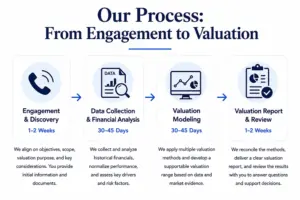
Our Process: From Engagement to Valuation
Step 1: Discovery Call (1 Day)
A confidential conversation to understand the purpose of your valuation such as a future sale, an exit plan, a partnership matter, an estate planning need, along with your business’s history, structure, and financial performance. The purpose of the valuation shapes the methodology, so this conversation matters.
Step 2: Financial & Market Analysis (30–45 Days)
We conduct a thorough review of your historical financial statements, typically the trailing three to five years, along with relevant industry and market data. We identify normalization adjustments, assess growth trends, and research comparable transactions within your industry.
Step 3: Valuation Report Development (30–45 Days)
We apply the appropriate valuation methods (income, market, and asset approaches) and reconcile them into a supported valuation range with full documentation of our methodology, assumptions, and conclusions.
Step 4: Delivery & Strategic Discussion
We walk you through the report in plain language so it’s not just the number; then you understand what’s driving it and what levers could move it. For clients planning a future sale or exit, this conversation often becomes the starting point for a multi-year value-building strategy.
Business Valuation Services We Provide
 Income approach valuation — discounted cash flow and capitalized earnings
We value your business on its ability to generate future economic benefit, using DCF or capitalized normalized earnings built on your historical performance and a defensible projection.
 Market approach valuation — comparable transaction analysis
We benchmark your company against similar businesses that have actually sold, adjusting comparable transaction data for differences in size, growth, and risk.
 Valuations for partnership buyouts and shareholder disputes
An independent number that takes the emotion out of a partner departure or ownership dispute and gives both sides something to work from.
 Valuations for management buyouts and internal ownership transitions
A credible starting point for the MBO process so the structure and financing can be designed around a number everyone agrees on.
 Periodic valuations for ongoing value tracking and strategic planning
Recurring valuations that let you track value over time, benchmark against industry comparables, and time growth, investment, and exit decisions.
 Valuations for family business transfer and succession planning purposes
A supported value for planning and negotiating an internal transfer to the next generation, before any financing or ownership conversations begin.
 Valuations for professional practice transitions — physician, dental, legal, and veterinary practices
Practice-specific valuations ahead of a partner buyout, a retirement transition, or a sale to a DSO, PE group, or successor.
 Buy-sell agreement valuation methodology design
We document an agreed-upon valuation methodology in advance, so a partner departure, disability, or death never turns into a valuation dispute.
 Asset approach valuation — net asset value analysis
We establish the fair market value of your underlying assets minus liabilities, a floor value that’s essential for asset-heavy businesses.
 Valuations for sale and exit planning purposes
A fair-market-value baseline you can negotiate from and measure progress against as you execute a multi-year exit strategy.
 Valuations for capital raises and investor negotiations
A professionally supported valuation to anchor investor conversations, grounded in your actual financial performance and market comparables.
Why Business Owners Choose Gildark Financial for Valuation
We Build Numbers That Hold Up.
Our valuations are grounded in rigorous, multi-method analysis, and are provided from a team with decades of experience.
We Explain the Number, Not Just Deliver It.
A valuation report full of jargon and formulas isn’t useful if you don’t understand what’s actually driving your number. We walk you through the analysis in plain language, and help you understand what could move that number if you have time before a transaction.
Tax, Accounting, and M&A Advisory Under One Roof.
Your valuation connects directly to your exit planning and your Individual Tax Strategy. Because all three live under one roof, your valuation is never disconnected from the rest of your transaction strategy.
We’re Built for San Diego’s Business Community.
From biotech and defense-adjacent businesses to professional services, hospitality, and trades companies, we understand the industry-specific factors that drive value differently across San Diego’s diverse economy.
Call us now
The solutions, insights, and guidance you need to achieve your financial goals are at your fingertips — but you have to make the call. Contact us online or call our office today to explore our full range of services with a knowledgeable financial professional.
Frequently Asked Questions
How much does a business valuation cost?
Valuation pricing depends on the complexity of your business, the purpose of the valuation, and the level of documentation required. A valuation intended for a future business sale typically requires more depth than one intended for internal planning purposes. We provide a clear, transparent scope and fee before any engagement begins.
How long does a valuation take?
Most valuation engagements take up to 90 days from kickoff to final report delivery, depending on the complexity of your financials and the availability of comparable market data for your industry.
What’s the difference between a valuation for a sale and a valuation for succession or internal planning purposes?
The underlying methodology is often similar, but the purpose shapes how the analysis is documented and what standard of value is applied. A valuation intended to support a sale focuses on fair market value to a hypothetical willing buyer — what a reasonable buyer would pay in an arm’s-length transaction based on your financial performance and market comparables. A valuation for succession or internal planning purposes uses the same analytical rigor but is documented around the specific decision it’s supporting: an internal transfer price, a buy-sell agreement trigger, or a capital raise negotiation.
It’s worth noting that valuations intended for IRS submission — estate tax, gift tax, 409A compliance, or charitable contribution deductions — carry specific regulatory requirements and must be performed by a Certified Valuation Analyst (CVA), Accredited Senior Appraiser (ASA), or similarly credentialed professional. That falls outside our scope. If you need a valuation for tax or regulatory filing purposes, we’ll tell you directly and refer you to the right resource. What we do exceptionally well is the planning, strategic, and transactional side giving business owners a rigorous, evidence based number they can actually build decisions around.
Can a valuation help me even if I’m not planning to sell anytime soon?
Yes. Many business owners request a valuation simply for clarity, to track value over time, or to begin building toward a future exit years in advance. Understanding your current value, and what’s actually driving it, is one of the most useful exercises a business owner can undertake regardless of immediate sale plans.
Will my valuation match what a buyer is actually willing to pay?
A professional valuation gives you a well-supported estimate of fair market value but the price a specific buyer is willing to pay can diverge based on strategic fit, synergies, competitive dynamics in a sale process, and other deal-specific factors such as internal or external sale options. A valuation is your anchor in negotiation, not a guarantee of a specific sale price.
Do I need a Quality of Earnings (QoE) review and a valuation, or just one?
They serve different purposes and work best together. A valuation answers “what is the business worth?” while a Quality of Earnings analysis answers “can the earnings support the underlying valuation and actually be trusted?”. A QoE is becoming more common during the sale of a business. Most business owners preparing for a sale benefit from both, starting with a valuation to understand where they stand, then a QoE analysis as we get closer to the actual transaction process.

 619-736-3044
 Email Us
 1597 N Johnson Ave, El Cajon CA 92020