



You've Built Something Valuable. How You Exit Determines How Much of It You Keep.
Selling your business to private equity or taking on a PE investment is one of the most complex financial events of your life. The deal terms get enormous attention. The tax structure of those terms often gets far less. That gap can cost business owners millions of dollars in avoidable tax consequences, financial reporting surprises, and post-transaction compliance failures.
At Gildark Financial Solutions Group, our PE exit accounting and advisory services are built specifically for business owners who are preparing for, navigating, or have recently completed a private equity transaction. We serve as the tax and accounting layer of your deal team; the professionals who make sure the financial structure of your exit works as well on paper as it does in the term sheet. This practice connects directly to our business tax strategy and business valuation services to deliver a fully integrated pre- and post-transaction advisory practice.
Signs Your Exit Isn’t as Buttoned-Up as You Think
We talk to business owners who are approaching or mid-process in a PE transaction. Here’s what we hear:
- “The buyer’s team showed up with a detailed picture of our financials. I realized we didn’t have one.”
- “I agreed to deal terms before I understood what an asset sale versus a stock sale actually meant for me after tax.”
- “My books weren’t in good shape going into due diligence. The buyer used that as leverage.”
- “The deal closed. Then I found out what year-of-sale taxes looked like. Nobody had planned for it.”
- “I have a rollover in the new entity and I’m not sure I fully understood what I was agreeing to.”
Every one of these situations is avoidable, but only with the right team engaged before the process moves too far to shape it.

You Wouldn't Sell Your Business Without a Lawyer. Why Would You Do It Without a Tax Architect?
Investment bankers are motivated to close. Lawyers are managing legal risk. PE buyers have their own diligence teams whose job is to find every reason to adjust the price downward. In a PE transaction, the accounting and tax perspective that is most consistently underrepresented is the seller’s, and that gap is expensive.
The after-tax proceeds you walk away with are determined not just by your valuation — but by how the deal is structured, how your books hold up in diligence, and whether anyone planned for your personal tax consequence before the wire landed. These are not afterthoughts. They’re where the money is.

The Tax and Accounting Gaps Most Business Owners Don't See Until It's Too Late
PE transactions move fast and involve sophisticated counterparties whose primary objective is to acquire your business at terms that maximize their return. They will arrive with a detailed picture of your financials. The question is whether your picture of your own financials is equally sharp, and whether your tax and accounting position is structured to serve your interests in the transaction.
- Financial statements that aren’t diligence-ready. PE buyers conduct rigorous Quality of Earnings (QoE) analysis. Books that are behind, inconsistent, or prepared without GAAP discipline create leverage for the buyer to renegotiate price or terms. Sometimes dramatically.
- Unexpected tax liabilities surfaced in diligence. Unpaid payroll taxes, aggressive deductions, unreported income, or entity structure issues discovered during buyer diligence can derail a deal or result in significant price adjustments and escrow holdbacks.
- A deal structure that isn’t tax-optimized for the seller. Asset sales vs. stock sales, installment note structures, earnouts, and rollover equity all carry different tax consequences. Most business owners don’t understand the difference until after they’ve agreed to terms.
- No plan for the personal tax consequence. A successful exit can generate the largest single taxable event of a business owner’s life. Without a personal tax strategy in place before closing, a significant portion of the proceeds can evaporate in federal and California taxes.
- Post-transaction compliance complexity nobody planned for. Rollovers into the new PE entity, stub period returns, management equity arrangements, and ongoing advisory obligations all create accounting and tax obligations that most sellers aren’t prepared to manage.
Phase 1: Pre-Transaction Advisory & Getting Deal-Ready
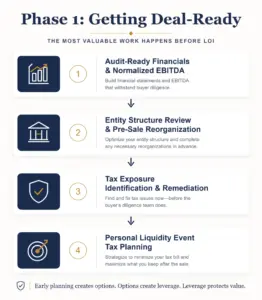
The most valuable work we do in a PE transaction happens before a letter of intent is signed.
The earlier we’re engaged, the more we can shape the outcome.
Financial Statement Audit-Readiness & Clean-Up
PE buyers rely on your financials to set valuation. If your books are maintained on a cash basis, contain intermingled personal and business expenses, lack proper accruals, or present EBITDA in a way that won’t survive a QoE analysis, the buyer’s adjustments will come out of your purchase price. We review and, where necessary, reconstruct your financial statements and prepare normalized EBITDA analyses that your investment banker can use to support your asking price.
Entity Structure Review & Pre-Sale Reorganization
The tax treatment of your sale is largely determined by your entity structure at the time of the transaction. We conduct a pre-transaction entity review that evaluates your current structure against the likely deal structures you’ll encounter and identifies whether any reorganization (conversion, merging, or simplification) should happen before you come to market. Some of these moves require time to be effective; this work must happen well in advance of signing.
Tax Exposure Identification & Remediation
Before a buyer’s diligence team finds your tax exposure, we should find it first. We conduct a pre-sale tax review covering payroll tax compliance, sales tax filings, state and local tax obligations, deduction substantiation, and any positions on your returns that could attract scrutiny. Addressing issues proactively is far better than having them surface mid-diligence and give the buyer negotiating leverage.
Personal Tax Planning for the Liquidity Event
A PE exit can generate a single-year taxable event that exceeds a business owner’s cumulative prior lifetime income. In California, the combined federal and state tax rate on ordinary income and capital gains can approach or exceed 50%. The difference between a planned liquidity event and an unplanned one can be measured in seven figures.
We work with selling business owners on:
- Installment sale analysis — spreading gain recognition across multiple tax years
- Opportunity Zone investment planning — deferring and partially excluding capital gains
- Charitable giving strategies — donor-advised funds, CRTs, and direct gifts of pre-liquidity equity
- Qualified Small Business Stock (QSBS) analysis — Section 1202 exclusion eligibility
- Retirement plan funding strategies to shelter income in the year of sale
- State tax planning — especially for owners considering a change of California domicile
Phase 2: Transaction Support — Keeping Pace With the Deal
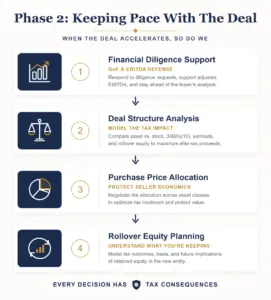
Once a letter of intent is signed, transactions move quickly. Diligence periods are compressed, document requests multiply, & the financial and tax information you need to produce becomes the foundation on which the entire deal is built or dismantled. We stay in lockstep with your deal team throughout.
Financial Diligence Support
The buyer’s QoE team will comb through your financials looking for normalizing adjustments such as one-time items, owner-related expenses, non-recurring revenues, and accounting inconsistencies that affect the EBITDA they’re buying. We support you through this process by preparing your own version of adjusted EBITDA, responding to information requests, and ensuring that your team is never caught flat-footed.
Deal Structure Tax Analysis
Asset sale or stock sale? Section 338(h)(10) election? Earnout structure? Rollover equity? Each element of deal structure carries a different tax consequence for the seller and some of those differences are substantial. We model the after-tax proceeds of multiple deal structures so you can negotiate from a position of full information, not react to what the buyer proposes.
Purchase Price Allocation
In an asset sale, how the purchase price is allocated across asset classes determines the tax treatment of each piece. Buyers and sellers have opposing interests in this allocation, and the negotiation of purchase price allocation is one of the highest-stakes tax decisions in any deal. We represent your interests in this negotiation and ensure the final allocation is reflected correctly in your returns.
Rollover Equity Planning
Many PE transactions involve the seller retaining a portion of equity in the new entity, also known as a rollover. This can be an attractive structure, but it also creates significant tax complexity: the treatment of the rollover as taxable or non-taxable exchange, the basis in the new equity, the character of future gains, and the implications for your personal tax planning over the hold period. We model the rollover economics in full detail so you understand exactly what you’re keeping and what you’re deferring.
Phase 3: Post-Transaction Compliance & Ongoing Advisory
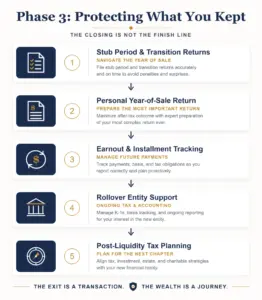
The deal is closed. The wire has landed. And the tax and accounting work is far from over. Chances are, you are now also a High-Net-Worth-Individual.
Stub Period & Transition Year Returns
The year of a sale typically involves a short-period (stub period) tax return for the entity through the closing date, a final return for the selling entity in its current form, and often the first return for the new holding structure. These returns are more complex than standard annual filings and require careful coordination between the pre- and post-closing accounting records.
Personal Tax Return – Year of Sale
The year of closing is almost always the most complex personal tax return a business owner will ever file. Multiple forms of consideration, capital gains computations, installment sale reporting, and potential charitable deductions all converge in a single filing. This return needs to be prepared by someone who was present for the transaction, not someone encountering it for the first time in April. We handle the year-of-sale return as a natural extension of our pre-transaction engagement.
Earnout & Installment Payment Tracking
If your deal includes an earnout or seller note, there are ongoing tax obligations such as reporting installment income correctly, tracking the basis in your installment receivable, and planning around the tax consequences of each payment as it’s received. We manage this tracking on an ongoing basis so nothing falls through the cracks.
Rollover Entity Tax & Accounting
If you retained equity in the new PE-backed entity, you now have an ongoing interest in a new organization with its own accounting and reporting requirements. We provide ongoing tax and accounting support including K-1 management, basis tracking, and planning around future distributions and the eventual next exit.
Post-Liquidity Personal Tax Planning
A successful exit fundamentally changes your financial life. We work with post-exit clients on investment income planning, charitable strategy, estate plan integration, and multi-year tax projections that reflect the new reality of your financial position. The planning work that begins at closing is some of the most consequential you’ll ever do.

Financial statement clean-up and diligence preparation

Normalized EBITDA analysis and add-back documentation

Entity structure review and pre-sale reorganization

Tax exposure identification and remediation

Personal liquidity event tax planning — installment sales, OZ, QSBS, charitable strategies

Pre-close retirement plan optimization

Financial diligence support and QoE coordination

Deal structure tax modeling — asset vs. stock, 338(h)(10), section 1202

Purchase price allocation negotiation support

Rollover equity structure and tax analysis

Earnout and seller note tax planning

Stub period and transition year entity returns

Year-of-sale personal tax return preparation

Earnout and installment payment tracking and reporting

Rollover entity K-1 management and basis tracking

Post-liquidity personal tax planning and ongoing advisory

Estate plan integration and multi-year tax projections
What Makes Our PE Advisory Practice Different
We Work for the Seller — Not the Deal.
Investment bankers are motivated to close. Lawyers are managing risk. Buyers have their own diligence teams. We come in exclusively on your side analyzing deal structures, preparing your financials, and ensuring your tax position is protected throughout the process.
We Were Here Before the Deal and We’ll Be Here After.
Our value in a PE transaction is highest when we’ve been working with you before the deal comes together, and when we know your books, your structure, your history, and your personal financial picture. And our value continues well after closing, through stub returns, personal filings, and ongoing post-liquidity planning. This is not a transaction-only engagement.
Tax and Accounting Under One Roof.
Most business owners going through a PE transaction are managing their accountant and their tax advisor as separate relationships, often with limited communication between them. At Gildark Financial, both functions are integrated. The people who know your accounting records are the same people building your personal and business tax strategy. That coordination eliminates the gaps that cost sellers money.
We Understand California’s Impact on Your Exit.
California adds a layer of complexity to every PE transaction that affects a California-based business owner. From the treatment of earnouts and installment sales to the California FTB’s aggressive approach to residency and source income, state tax planning is not an afterthought in a California exit, it’s a core part of the strategy. Our team manages federal and California consequences in parallel throughout the transaction.
Call us now
The solutions, insights, and guidance you need to achieve your financial goals are at your fingertips — but you have to make the call. Contact us online or call our office today to explore our full range of services with a knowledgeable financial professional.
Frequently Asked Questions
When should I engage a tax and accounting advisor for a PE transaction?
As early as possible, and ideally one to two years before you expect to bring the business to market. The most impactful work (entity restructuring, financial statement normalization, tax exposure remediation, personal tax planning) requires lead time to be effective. If you’re already in a process, engage us immediately because there’s still meaningful work to be done even mid-diligence.
What’s the difference between an asset sale and a stock sale, and why does it matter?
In an asset sale, the buyer gets a stepped-up tax basis in the assets, which is generally preferred by buyers. For sellers, more of the gain may be taxed as ordinary income rather than capital gains. In a stock sale, the buyer purchases your ownership interest, which is typically more tax-favorable for sellers. The difference in after-tax proceeds between the two structures can be substantial, and many sellers don’t model both options before agreeing to deal terms.
What is a Quality of Earnings (QoE) analysis and how should I prepare for it?
A QoE is an analysis performed by the buyer’s accounting team that evaluates the reliability and sustainability of your reported earnings. They’re looking for normalizing adjustments (items that inflate or deflate your recurring EBITDA) and will use their findings to negotiate price. Preparing your own normalized EBITDA analysis before diligence begins, and ensuring your books can support it, is one of the most valuable things you can do before a deal process.
Can you help if I’ve already signed an LOI?
Yes. The period between LOI and closing is intensive but there is still meaningful tax and financial work to be done; this includes diligence support, deal structure analysis, purchase price allocation positioning, and personal tax planning for the close. Engage us immediately if you’re mid-process.
What happens to my taxes in the year of the sale?
The year of sale is typically the most complex tax year a business owner will experience. Capital gains, ordinary income from asset allocations, installment income, and potential charitable deductions all interact in a single filing. We handle year-of-sale returns as a direct continuation of our pre-transaction engagement. There should be no surprises.
Do you work with PE-backed businesses post-close on ongoing accounting?
Yes. Many of our PE advisory clients engage us for ongoing tax and accounting support post-close. This includes clients with rollover equity holders who have continuing obligations in the new entity, and for founders who want to maintain a trusted advisor relationship through the hold period and into the next exit.

 619-736-3044
 Email Us
 1597 N Johnson Ave, El Cajon CA 92020