



Keep More of What You Earn. Pay Less Legally, Strategically, and on Your Terms.
There’s a version of your financial life where you pay only what the tax code actually requires, and not a dollar more. It doesn’t happen by accident, and it doesn’t happen in April. It happens through deliberate, year-round individual tax strategy, avoidance, reduction, and deferral planning that aligns every financial decision you make with a clear picture of its tax consequence.
At Gildark Financial Solutions Group, our personal tax strategy services in San Diego are built for individuals who are tired of being surprised by their tax bill, and are ready to do something about it. See how our personal tax preparation and tax planning services work together to build a complete picture of your tax position, year after year.
Signs You’re Paying More Than You Should
We hear versions of the same story from individuals across San Diego every week:
- “I had no idea I’d owe that much. My accountant just told me in March and there was nothing left to do.”
- “I sold some investments last year. Nobody told me I should have timed it differently.”
- “I maxed my 401(k) but I feel like I’m still paying way more than I should be.”
- “I exercised stock options and got hit with a tax bill I didn’t see coming.”
- “I feel like I’m always reacting to my taxes instead of planning for them.”
If any of those feel familiar, know you’re not alone. The tax code isn’t designed to be simple. It’s designed to be navigated. Most individuals just don’t have anyone navigating it for them.

Most People Pay More Than They Have To. Here's Why.
It’s not carelessness; it’s timing and the absence of a plan. Dozens of provisions in the tax code exist specifically to allow taxpayers to defer income, accelerate deductions, offset gains, and structure their financial lives more efficiently. Most individuals never access them and it’s not because they’re ineligible, but because no one is looking at their full picture proactively.
Here’s what that looks like in practice:
-
- The investment sale. You sell a position in Q4 without realizing you could have harvested offsetting losses earlier in the year. The result: a tax bill that could have been significantly smaller.
- The year-end bonus. You receive a large bonus in December without any strategy in place to shelter it. Every dollar is taxed at your top marginal rate.
- The real estate transaction. You sell a property without exploring installment sale treatment, 1031 exchange options, or opportunity zone deferral. The gain hits all at once.
- The retirement contributions. You max your 401(k) but never explored a backdoor Roth, a defined benefit plan, or a SEP-IRA — options that could potentially shelter significantly more.
- The equity compensation. You exercise ISOs or RSUs without understanding the AMT implications or the optimal timing window. The tax consequence is painful and avoidable.
These aren’t edge cases. They’re what we see every day. And in almost every instance, the window to act had already closed before the client called us.

As a Taxpayer, Are You Proactive or Reactive?
Most people don’t choose to be reactive. It happens gradually as life gets busy, April arrives faster than expected, and taxes become something you deal with rather than something you manage. Before long, you’re making financial decisions without any real sense of what they’ll cost you come tax time. By the time you find out, it’s too late to do anything about it.
Here’s the honest truth: the majority of taxpayers are reactive. They call their tax professional in late March with documents and a hope that it’ll work out. Sometimes it does. More often, it works out worse than it needed to, because every strategic opportunity that existed during the year has already passed.
Proactive taxpayers think differently. They engage their tax team before decisions are made, not after.
Consider the difference:
- The reactive taxpayer sells an investment property in October, then calls in February to find out what they owe.
- The proactive taxpayer calls before the sale closes, and that one conversation can be worth tens of thousands of dollars.
The same principle applies to stock compensation, selling a home, large bonuses, retirement contributions, and every major financial decision you make throughout the year. The decisions are happening all year. The question is whether your tax strategy is happening alongside them, or simply catching up to them.

What Individual Tax Deferral, Avoidance, & Strategy Actually Means
These aren’t loopholes. They’re fundamental features of the U.S. tax code, built in deliberately, not exploited. Tax avoidance is the legal use of the code to minimize what you owe: claiming every deduction and credit you’re entitled to, and structuring decisions within the rules as written. Tax deferral is a specific form of avoidance, moving a tax obligation to a later period, often at a lower future rate, so money that isn’t taxed today keeps compounding in the meantime. Tax reduction covers strategies that permanently lower your liability rather than postponing it. None of this is tax evasion, which is illegal. Everything we do falls under the first three, which are all fully compliant, properly documented, and defensible.
Our individual tax strategy practice is built around four core disciplines that draw from all three:
1. Income Timing & Characterization
Not all income is taxed the same way, however your income type matters just as much as how much you earn. We work with clients to time income across tax years, shift ordinary income into preferentially taxed categories where possible, and structure compensation to reduce your effective rate.
2. Deduction Acceleration & Bunching
A deduction bunching strategy (concentrating deductions into alternating tax years) can unlock meaningful savings that flat-year filing never captures. We identify which deductions you’re leaving on the table and build a multi-year approach that maximizes their impact, including charitable giving strategies, mortgage interest timing, and state and local tax planning.
3. Retirement & Deferred Compensation Planning
Beyond a standard 401(k), high earners often have access to defined benefit plans, executive deferred compensation arrangements, backdoor Roth conversions, and Health Savings Accounts that can shelter tens of thousands of dollars per year. We evaluate your full compensation picture and build a contribution strategy that maximizes deferral within your cash flow constraints.
4. Capital Gains Management & Loss Harvesting
Investment portfolios accumulate unrealized gains and losses throughout the year. Tax-loss harvesting (strategically realizing losses to offset gains) is one of the most consistently valuable strategies available to investors with taxable accounts. We align your portfolio activity with your overall tax position so investment decisions and tax consequences are never made in isolation.

High earners and dual-income households
climbing into higher tax brackets faster than their planning has kept pace, looking to reduce their effective tax rate, avoid bracket-creep surprises, and stop overpaying simply because no one is coordinating their full financial picture.

Investors and portfolio holders
with taxable brokerage accounts, concentrated stock positions, or significant unrealized gains who need a coordinated strategy around loss harvesting, gain timing, and lot selection, not a once-a-year conversation after the damage is done.

Real estate owners and investors
managing rental income, depreciation recapture, cost segregation opportunities, 1031 exchanges, or the tax consequences of a planned property sale, where the difference between proactive and reactive planning can mean tens of thousands of dollars.

Executives and corporate employees
navigating RSUs, ISOs, NQSOs, ESPPs, deferred compensation plans, and the AMT exposure and timing complexity that comes with equity-based compensation, especially around vesting events, exercises, and liquidity windows.

Self-employed professionals, consultants, and business owners
who have far more control over the timing of income and expenses than W-2 employees do, and who benefit the most from proactive, year-round planning rather than a once-a-year filing.

Individuals approaching a major financial event
such as a home sale, an inheritance, a divorce settlement, a business liquidity event, a retirement transition, or a significant windfall, where the tax consequence of timing, structure, and sequencing can be substantial and largely avoidable with the right planning in place.

Multi-generational families and individuals with inherited wealth
navigating step-up in basis considerations, trust distributions, and the tax implications of assets that didn’t originate from their own earned income.

Individuals relocating in or out of California
who need to understand residency rules, source income exposure, and the tax consequences of a domicile change before (not after) the move happens.
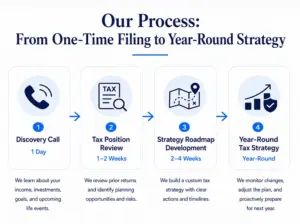
Our Process: From One-Time Filing to Year-Round Strategy
Most tax professionals see you in February or March, prepare your return, and send you a bill. We operate differently.
Step 1: Discovery Call (1 Day)
A focused conversation to understand your current situation, your income sources, investment activity, major life events on the horizon, and what “getting this right” actually means for you. No sales pitch. Just an honest look at where you are and where the biggest opportunities lie.
Step 2: Tax Position Review (1–2 Weeks)
We conduct a comprehensive review of your last two to three years of tax returns identifying what’s been missed, what’s been overpaid, and where the most significant planning opportunities exist. Most clients are surprised by what we find.
Step 3: Strategy Roadmap Development (2-4 Weeks)
Using the review findings, we build your custom individual tax strategy roadmap using your expected income, planned transactions, deferral opportunities, and the specific actions we’ll take before year-end. You’ll know exactly what we’re doing, why, and what it’s worth before we begin.
Step 4: Year-Round Tax Strategy & Monitoring
From here, we stay engaged throughout the year, adjusting your strategy as income, investments, and life events shift. At year-end, your return is prepared with full knowledge of every decision made. The moment it’s filed, we’re already planning for next year.
Individual Tax Strategy & Deferral Services We Provide
 Year-round tax projection and planning
We model your tax position as the year unfolds, so you know where you’ll land in time to do something about it.
 Capital gains timing, harvesting, and deferral
We coordinate when gains are realized and pair them with available losses, so portfolio decisions and tax consequences stop happening in isolation.
 Retirement contribution optimization
401(k), IRA, Roth, SEP, defined benefit: We look past the standard 401(k) to find which combination of accounts shelters the most income within your cash flow.
 Deduction bunching and itemization strategy
We concentrate deductions into the years where they clear the standard deduction and actually count, rather than spreading them thin every year.
 Equity compensation planning
RSUs, ISOs, NQSOs, ESPP: We map exercise, vesting, and sale windows against AMT exposure and holding periods before the shares move, not after.
 Real estate tax strategy
Rental income, depreciation, 1031 exchanges, installment sales: We plan how property income is sheltered and how gains are recognized when you sell, including exchange and installment options.
 Charitable giving strategies
Donor-advised funds, qualified charitable distributions, appreciated asset gifting: We structure your giving so the same generosity produces a materially better tax result.
 Roth conversion analysis & backdoor Roth planning
We identify the years and amounts where converting makes sense, weighing today’s bracket against your long-term trajectory.
 Alternative Minimum Tax (AMT) management
We track your AMT exposure ahead of time and time decisions around it, so it never shows up as a surprise line on the return.
 Multi-year income smoothing
For self-employed and variable-income earners: We level uneven income across tax years to keep you out of the highest brackets in your strongest ones.
 Federal and California state tax coordination
We plan both layers together, because California’s non-conformity means a strategy that works federally can quietly cost you at the state level.
 Life event tax planning
Sale of home, inheritance, divorce, retirement: We plan the tax consequences of major transitions before they happen, when timing and structure are still yours to control.
Individual Tax Strategy in California: Why the Stakes Are Higher Here
- California’s tax environment makes proactive planning not just valuable, it makes it essential. With a top marginal income tax rate of 13.3% stacked on top of federal rates, high-income California residents face a combined marginal rate that can exceed 50% on ordinary income. Every planning decision carries more weight here than in almost any other state.
- No capital gains preference. California taxes long-term capital gains as ordinary income unlike federal preferential rates. This makes gain-timing and deferral strategies especially impactful for California residents.
- No conformity to many federal deferral provisions. Strategies that work federally may need to be restructured for state purposes. We manage both layers simultaneously.
- Community property rules. California’s community property laws affect how income and assets are allocated between spouses, with significant implications for filing strategy, estate planning, and investment ownership structures.
- FTB enforcement. The California Franchise Tax Board is one of the most aggressive state tax agencies in the country. Clean, well-documented filings and properly structured deferral strategies are your best protection.
Why Gildark Financial for Individual Tax Strategy
We See the Whole Board.
Most tax preparers see your W-2 and your 1099s. We see your income, your investments, your real estate, your retirement accounts, your equity compensation, your expected life events, and your multi-year trajectory all at once. That complete view is what makes meaningful strategy possible.
We Work Year-Round, Not Just in April.
Meaningful tax strategy can’t happen in March. It requires ongoing monitoring, mid-year check-ins, and real-time responsiveness to changes in your financial life. That’s the model we operate on, and it’s what separates proactive clients from reactive ones.
We’re Licensed to Represent You.
Our Enrolled Agents hold federal credentials to represent clients before the IRS in all matters including audits, appeals, and collections. If your return is ever questioned, you have a credentialed professional in your corner who already knows your full history.
We Coordinate Tax and Accounting Under One Roof.
When your tax strategy and your accounting records are managed separately, things fall through the cracks. At Gildark Financial, both functions are integrated which means your strategy is always grounded in your actual numbers.
We Communicate in Plain Language.
You’ll always know what we’re doing, why we’re doing it, and what it means for your bottom line. No jargon, no opacity, no surprises.
Call us now
The solutions, insights, and guidance you need to achieve your financial goals are at your fingertips — but you have to make the call. Contact us online or call our office today to explore our full range of services with a knowledgeable financial professional.
Frequently Asked Questions
When is the right time to start individual tax planning?
Now, and continuously. The strategies with the most impact require action during the tax year, not after it closes. If your prior year’s return was your first signal that something needed to change, today is the right time to act.
How is tax strategy different from tax preparation?
Tax preparation is the act of accurately reporting what happened. Tax strategy is the work of shaping what happens by structuring income, timing transactions, and making decisions with full awareness of their tax consequences before they’re locked in.
Can you work with my existing financial advisor or investment manager?
Yes, and we encourage it. The most effective tax strategies are coordinated across your full financial team. We work collaboratively with investment advisors, estate attorneys, and financial planners to ensure everyone is operating from the same playbook.
Do I need a high income to benefit from tax strategy services?
Not necessarily. What matters is complexity; multiple income streams, investments, real estate, significant life events, or equity compensation all create planning opportunities regardless of the total dollar amount.
What’s the difference between tax avoidance, deferral, and evasion?
These terms get confused constantly, and that confusion costs people money. It also makes them hesitant to use perfectly legal strategies out of fear because they sound illegal.
Tax avoidance is the legal use of the tax code to minimize what you owe, claiming every deduction and credit you’re entitled to, choosing the most favorable legal structure for your income, and making decisions that reduce your liability within the rules as written. This isn’t a loophole. It’s exactly what the tax code is designed to allow, and in many cases, designed to encourage. Retirement contributions, charitable giving, and homeownership all exist as deliberate avoidance incentives written into the law itself.
Tax deferral is a specific form of avoidance, legally moving a tax obligation to a later period rather than eliminating it, often at a lower future rate. A 401(k) contribution, a 1031 exchange, and an installment sale are all deferral strategies.
Tax reduction covers strategies that permanently lower your liability rather than just postponing it; this includes bracket management, deduction bunching, and credit optimization.
Tax evasion is illegal and includes concealing income, falsifying deductions, or misrepresenting transactions to the IRS.
Everything we do at Gildark Financial falls under avoidance, deferral, and reduction. We never engage in tax evasion, and every strategy we recommend is properly documented and fully defensible if your return is ever examined.

 619-736-3044
 Email Us
 1597 N Johnson Ave, El Cajon CA 92020