



A Successful Business Exit Isn't Something That Happens to You. It's Something You Build Deliberately, and Well in Advance.
Most business owners spend years building their company and almost no time planning how they’ll leave it. When the moment arrives, whether a serious buyer, a health event, a partnership change, burnout, or simply the right time, they’re making one of the largest financial decisions of their lives with little preparation and even less runway. Exit planning is the discipline of making sure that’s never you.
At Gildark Financial Solutions Group, our business exit planning services in San Diego are built for business owners who want a clear, comprehensive roadmap for leaving their business on their own terms; financially prepared, tax-optimized, and with the personal side of the transition thought through as carefully as the business side. See how this connects to our business valuation services and business tax strategy for a fully coordinated exit strategy.
Signs You’re Building a Business Without an Exit Strategy
We hear versions of the same story from business owners across San Diego:
- “I want to exit in the next three to five years, but I don’t have a real plan for what that looks like.”
- “My business is my biggest asset and I have almost nothing in place for retirement.”
- “I know I need to increase the value of my business before I sell, but I don’t know exactly what a buyer actually values.”
- “I’ve never modeled what I’d actually walk away with after taxes, transaction costs, and debt payoff.”
- “If something happened to me tomorrow, my business would be in chaos. There’s no real plan.”
If any of those sound familiar, you’re not behind because you don’t care, you’re behind because running a business is all-consuming, and the exit feels far enough away to defer. The cost of deferring is measured in the value you leave on the table when you finally do exit.

Are You Reacting to Your Exit, or Building Toward It?
Most business owners are reactive when it comes to their exit. A buyer appears, a health event forces the issue, or a partner wants out and suddenly they’re making multi-million-dollar decisions under time pressure with incomplete information and limited options.
Proactive exit planning changes the dynamic entirely. Instead of reacting to whatever comes, you’ve already answered the questions that matter most: What is my business worth today, and what would it take to increase that value? How much would I actually keep after taxes? What does my personal financial life look like on the other side of this exit? Who continues the business, or how does a buyer inherit it in a way that protects its value?
The business owners who get the best outcomes aren’t necessarily the ones with the best businesses, they’re the ones who started planning years earlier than everyone else.

The Exit Planning Methodology: Discover. Prepare. Decide.
We don’t hand you a binder and call it an exit plan. We walk alongside you through a structured, three-phase process that builds clarity, creates options, and positions you to make the most important financial decision of your life from a position of strength, not urgency. Our workshops together will also include your family, your management team, and other key members of your functional team to ensure your success.
Phase 1: Discover — Know Exactly Where You Stand
You can’t build a credible exit strategy around assumptions. The Discover phase is where we establish the objective, evidence-based picture of your business and your personal financial life so that every decision in the phases that follow is grounded in reality, not optimism.
- Business Valuation. We conduct a rigorous valuation of your business reconciled into a professionally calculated value range, and grounded in your actual financial performance and real market data. This is your baseline: the number every other exit decision is built around, and the benchmark against which your value-building progress will be measured over time.
- Personal & Financial Assessment. We assess your personal and financial readiness for an exit by understanding your post-exit income needs, the role your sale proceeds play in your retirement, and whether your current target value is actually sufficient to fund the life you want after the business. Many business owners discover in this phase that their number needs to be higher (or that they’re closer to ready than they thought).
These two assessments together produce your Prioritized Action Plan — a clear, ranked list of the highest-impact things to address before your exit, ordered by value to your outcome.
Phase 2: Prepare — Build the Business and the Life You’re Exiting Toward
Knowing where you stand is step one. Step two is doing the work that closes the gap between where you are and where you need to be. The Prepare phase runs in continuous 90 days planning cycles until you’re genuinely exit-ready. Work happens simultaneously on two fronts:
Personal & Financial Readiness
We build and refine the personal financial plan that sits alongside your business exit strategy ensuring that your post-exit life is as thoroughly planned as the exit itself. This includes:
- Personal financial planning. Retirement income modeling, investment strategy for post-exit assets, insurance review, and cash flow planning for the transition period.
- Exit tax strategy. Structuring decisions around entity form, timing of asset recognition, installment sale analysis, opportunity zone considerations, and charitable giving strategies, all built into the plan before a buyer is ever at the table.
- Estate and legacy coordination. Coordinating with your estate attorney to ensure your exit plan and your legacy plan are aligned, not working against each other.
Business Value Enhancement & Risk Reduction
We work alongside you to address the business-side factors that directly drive your valuation and your attractiveness to buyers or successors:
- Value enhancement strategy. Identifying and executing on the specific operational, financial, and structural improvements most likely to move your valuation thus reducing customer concentration, building recurring revenue, strengthening management depth, and documenting what makes your business run.
- Risk mitigation. Addressing the vulnerabilities a buyer’s team would flag like key-person dependency, undocumented processes, contract gaps, or financial statement inconsistencies that would create leverage against your price.
- Financial statement readiness. Ensuring your books are current, accurate, and presented in a way that supports your valuation rather than creating questions about it.
At the end of each planning cycle, we assess progress against your Prioritized Action Plan, update your valuation, and refine your strategy. The process continues until you’re genuinely prepared to make the most important financial decision of your business life.
Phase 3: Decide — Grow or Exit, on Your Terms
With a professionally calculated valuation, a strengthened business, and a personal financial plan in place, you arrive at the Decide phase from a position of real knowledge and genuine choice. The question is no longer “I think I might want to sell someday”. It now becomes “I know what my business is worth, I know what I need from this exit, and I know what my options are.” That’s a fundamentally different conversation.
- Keep and Grow. If the business isn’t yet where it needs to be (in value, in operational readiness, or in your personal financial picture), the right decision may be to continue through another planning cycle, executing against your Prioritized Action Plan until the timing is right. Staying is a strategic choice, not a failure to exit.
- Exit. When you’re ready, we support the transition. Whether that’s a third-party sale, a PE transaction, a management buyout, or a family succession. The exit path you choose is executed with the same coordination and rigor as the planning that preceded it, including transaction support and personal tax planning through the close.
The most important thing about the Decide phase: you make the decision. Not a buyer who appeared at the wrong time, not a health event that forced your hand, not a partner situation that left you no room. You decide, because you planned.
What a Comprehensive Exit Plan Covers

1. Business Valuation Baseline
Every exit plan starts with a professionally calculated, evidence-based valuation of your business built on multiple valuation methods and grounded in your actual financial performance and market comparables. This is the number everything else is measured against, and the benchmark your value-building strategy is designed to move.
2. Personal Financial Readiness
Many business owners arrive at exit conversations without having answered the most fundamental personal question: do I actually have enough from this sale to support the rest of my life? We build a personal financial model alongside your exit plan, understanding your income needs post-exit, the role your proceeds play in retirement, and whether your target number is sufficient or needs to be higher before you pull the trigger.
3. Value Enhancement Strategy
Once we know where you are, we focus on what would make a buyer, or successor, pay more. This involves reducing customer concentration, building management team depth, strengthening recurring revenue, improving financial statement quality, and addressing the operational vulnerabilities that would give a buyer leverage to negotiate your price downward. These aren’t overnight fixes, and they’re the reason you need years, not months.
4. Exit Tax Planning
The tax structure of your exit — entity form at time of sale, asset vs. stock sale treatment, installment sale structuring, opportunity zone planning, and charitable strategies — can vary your after-tax proceeds by hundreds of thousands or millions of dollars. We build exit tax strategy directly into your plan from the beginning, not as a year-of-sale scramble. This is one of the areas where starting early delivers the largest and clearest return on the planning process.
5. Deal Structure Options
Not all exits look the same. A full third-party sale, a partial recapitalization, a management buyout, and a family transfer each has different tax implications, different risk profiles, and different timelines. We model the after-tax economics of your most likely exit scenarios so you can make informed decisions about which path actually serves your goals before you’re under the pressure of a live negotiation.
6. Transition & Continuity Planning
A business that falls apart the moment the owner steps away is worth less, demands a smaller multiple, and is harder to exit from. We help you identify and address key-person dependency, operational documentation gaps, management team depth, and continuity risks making your business both more valuable and more transferable, regardless of the exit path you choose.

Business owners with a two-to-five-year exit horizon
who want a structured, comprehensive strategy rather than a vague intention.

Those who want to sell at maximum value
and understand that building toward that number takes intentional work over time.

Owners whose business is too dependent on them personally
and who want to build transferable value before they exit.

Business owners who have never modeled their personal financial readiness
for an exit and want to understand if their target number is actually sufficient.

Those approaching major business milestones
such as a key employee departure, a partnership change, a health consideration, that make planning more urgent.

Owners who want to understand their deal structure options
before a buyer is at the table and the pressure is on.

Business owners who simply don’t have a plan
and know they should, regardless of how far away the transition feels.
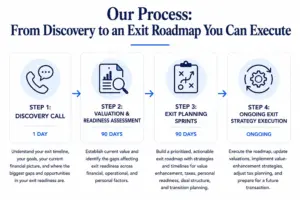
Our Process: From Discovery to an Exit Roadmap You Can Execute
Step 1: Discovery Call (1 Day)
A confidential conversation to understand your exit timeline, your goals, your current financial picture, and where the biggest gaps and opportunities in your exit readiness are. We ask the questions most advisors skip: What does your personal financial life look like after the exit? What would a buyer find if they looked at your business today? What’s your walk-away number? and do you actually know how you got there?
Step 2: Valuation & Readiness Assessment (90 Days)
We conduct a current business valuation and a comprehensive exit readiness review assessing your financial statements, entity structure, customer and revenue concentration, management team depth, and personal financial position. This is the foundation from which the rest of the plan is built.
Step 3: Exit Planning Sprints (90 Days)
Using the assessment findings, we build your comprehensive exit roadmap, a prioritized, executable plan covering value enhancement strategy, tax planning milestones, personal financial readiness, deal structure analysis, and transition planning. Not a binder that sits on a shelf, but a working strategy with clear actions and timelines.
Step 4: Ongoing Exit Strategy Execution
An exit plan is only valuable if it’s actually executed. We stay engaged throughout the process — conducting annual valuation updates, helping you implement value-enhancement strategies, adjusting your tax planning as your financial position evolves, and being ready to shift into transaction support when a buyer enters the picture.
Exit Planning in California: Why the Stakes Are Higher Here
California business owners face a more complex (and higher-cost) exit environment than almost anywhere else in the country. Every element of your exit plan carries more weight here.
- Combined tax rates can approach or exceed 50% on ordinary income. California taxes capital gains as ordinary income, stacked on top of federal rates. The tax structure of your exit has consequences that scale dramatically with the size of your transaction making proactive planning not just valuable, but essential.
- FTB residency rules create post-exit exposure. California aggressively audits high-income individuals who claim to have left the state after a liquidity event. If you’re considering a change of domicile in connection with your exit, this planning must start early and be properly documented.
- California’s non-conformity to federal provisions. Installment sale treatment, opportunity zone investments, and other deferral strategies may work differently at the state level than federally. We manage both layers simultaneously so nothing falls between them.
- Entity structure decisions carry extra California weight. California’s franchise tax, gross receipts rules, and divergence from certain federal entity elections make pre-exit restructuring decisions more nuanced and more consequential than in most other states.
Why Business Owners Choose Gildark Financial for Exit Planning

We Start Years Before the Transaction.
The most valuable exit advisory work happens long before a buyer is at the table. We engage early, build the strategy over time, and make sure the business you’re presenting has been intentionally prepared, not hurriedly assembled.
We Use The Exit Planning Institute Methodology, Tailored to You.
Our Discover → Prepare → Decide framework gives every client a structured, repeatable process with the flexibility to move at the pace that fits their business and their timeline. It’s not a checklist. It’s a continuous planning practice that evolves as you do.
Tax and Accounting Built In, Not Bolted On.
Your exit strategy and your tax planning are the same conversation, managed by the same team. Our tax services and accounting services work in lockstep with your exit plan so nothing falls between the advisors.
We Look at the Personal Side, Not Just the Business Side.
An exit that delivers a great headline number but leaves the business owner financially unprepared for what comes next is not a successful exit. We build your personal financial readiness into the plan from day one, not as an afterthought.
We Stay Engaged Through Execution.
A plan that isn’t executed is just a document. We stay involved throughout the years leading up to your exit; updating valuations, adjusting strategy as conditions change, and being ready to support the transaction when it comes just to name a few.
We’re Enrolled Agents Who Can Represent You.
Our Enrolled Agents hold unlimited representation rights before the IRS and California tax agencies. The tax positions we recommend in your exit plan are properly structured and fully supported if ever examined.
Call us now
The solutions, insights, and guidance you need to achieve your financial goals are at your fingertips — but you have to make the call. Contact us online or call our office today to explore our full range of services with a knowledgeable financial professional.
Frequently Asked Questions
How is exit planning different from a business valuation?
A business valuation answers “what is my business worth today?” Exit planning uses that answer as a starting point and builds a comprehensive strategy around it addressing value enhancements, personal financial readiness, tax strategy, and deal structure options over a multi-year horizon. Most clients benefit from starting with a valuation, then building an exit plan around it.
What does the Discover → Prepare → Decide process actually look like in practice?
The process begins with establishing your baseline with a business valuation and a personal financial assessment. From there, we build your Prioritized Action Plan and begin executing against it in planning cycles, typically structured around 90-day sprints. We revisit and refine the plan regularly, updating your valuation and adjusting priorities as the business evolves. When you reach a point of genuine exit-readiness (financially, operationally, and personally) you make the decision to exit or to continue growing strategically. The process is designed to be ongoing and adaptive, not a one-time document.
What if I don’t have a specific timeline for my exit?
That’s actually a good position to start from because it means you have time to do this right. An exit plan isn’t contingent on knowing exactly when you’ll exit. It’s about making sure you’re maximizing value and preparing appropriately so that when the right moment comes, you’re ready to act on it rather than scrambling to catch up.
How does exit planning connect to succession planning?
Exit planning is the broader strategy covering all possible exit paths, including a third-party sale. Succession planning specifically addresses internal transfers, to family or management. For business owners considering an internal transition, both plans are developed together, with our succession planning services addressing the specific internal transfer questions alongside the broader exit framework.
How much of a difference does starting early actually make?
Substantial. Business owners who engage three to five years before an intended exit consistently walk away with better outcomes such as higher valuations, lower tax bills, cleaner transitions, and fewer surprises. The strategies with the most impact require time to implement. A year out, your options are significantly more constrained.
Can you help with an exit even if my business isn’t a traditional corporation — professional practice, real estate, or trades?
Yes. Exit planning principles apply broadly, and we work with business owners across San Diego and the United States to help professional service firms, healthcare practices, trades and construction businesses, real estate operators, technology companies, and more. The specific valuation methodology and deal structure options vary by industry, and we calibrate accordingly.

 619-736-3044
 Email Us
 1597 N Johnson Ave, El Cajon CA 92020