



At a Certain Level of Wealth, Good Tax Advice Isn't Optional. It's One of the Highest-Return Investments You Can Make.
The financial lives of high-net-worth individuals don’t fit a standard tax return. Multiple income streams, concentrated equity positions, real estate portfolios, business ownership, trust structures, estate considerations, and philanthropic goals all intersect and carry major tax consequences, none of which are simple.While a general practitioner can file your return, high-net-worth individuals need a team that can engineer your tax position across all of it.
At Gildark Financial Solutions Group, our tax services for high-net-worth individuals in San Diego are built specifically for the complexity and stakes that come with significant wealth, from high-earning professionals building their first substantial net worth, to multi-generational families managing legacy assets and estate plans. See how this connects to our personal tax preparation, tax planning services, and individual tax strategy to form a fully integrated approach.
Signs Nobody’s Looking at Your Full Picture
We hear versions of the same story from high-net-worth individuals across San Diego:
- “My accountant does a fine job filing my return. But I never feel like anyone is actually planning ahead for me.”
- “I sold a concentrated position and the tax bill was significantly larger than I expected.”
- “My estate attorney and my financial advisor give me different advice and nobody seems to be coordinating.”
- “California taxes are killing me. I feel like I’m paying 50 cents on every dollar above a certain point.”
- “I have a trust, a business, real estate, and stock options. Nobody has ever looked at all of it together.”
If any of those landed, the issue isn’t your income, your investments, or your estate plan individually. It’s that nobody has ever looked at all of it at once. That’s precisely the gap we fill.

The Problem With Standard Tax Advice at High Income Levels
Most tax professionals are built for the middle of the market. Their systems and knowledge base are calibrated for W-2 earners with standard deductions and straightforward investment accounts. When you bring in a K-1 from a partnership, unvested RSUs from three different employers, a foreign bank account, a rental property with cost segregation, and a charitable remainder trust, you’ve exceeded what most tax practices are equipped to handle well.
The consequences of that mismatch are real:
- Missed deductions and credits that exist specifically for your situation but require specialized knowledge to access
- Poorly timed transactions that trigger avoidable tax events such as concentrated stock sold without loss harvesting, real estate disposed of without a 1031, equity exercised without AMT planning
- Strategies that work federally but create California exposure, because your advisor doesn’t manage both layers
- Estate plans that haven’t been updated to reflect current laws, or that contradict your current tax strategy
- Charitable vehicles set up without regard to their tax efficiency, leaving impact on the table along with the deduction
The cost of suboptimal advice scales with your income and wealth. At the high-net-worth level, what your advisor doesn’t know costs far more than their fee.

Three Stages of High-Net-Worth Tax Complexity
Wealth creates different tax challenges at different stages. We serve clients across all three and many who are moving between them:
The Accumulation Phase: $500K–$1M Income / $1M–$5M Net Worth
This is the stage where income is rising faster than most people’s tax planning has kept pace. The core opportunity here is aggressive deferral and strategic structuring, while maximizing retirement contributions, optimizing equity compensation, building a deduction strategy that doesn’t leave money in the standard deduction.This is the beginning of thinking about how current financial decisions are shaping your long-term tax position.
The Peak Earnings Phase: $1M+ Income / $5M–$20M Net Worth
At this level, tax complexity expands significantly. This includes income from multiple sources, business profits, investment returns, real estate cash flows, executive compensation, and potentially trust distributions. The California combined marginal rate can exceed 50% on ordinary income, making every planning decision carry substantial dollar consequences. This is where the full toolkit of HNW tax strategy becomes essential.
The Legacy Phase: $10M+ Net Worth / Multi-Generational Wealth
At this tier, taxes are inseparable from estate planning, trust structures, and legacy goals. The question is no longer just “how do I reduce this year’s tax bill?“, it’s “how do I transfer wealth to the next generation, fund my philanthropic priorities, and minimize estate and gift tax exposure in a way that’s integrated and coherent?” Gildark Financial serves as the catalyst for all of your long term tax strategies.

Multi-Source Income Tax Planning
High-Net-Worth (HNW) individuals rarely have a single source of income. We manage the tax treatment of wages, business distributions, investment income, real estate cash flows, trust income, retirement distributions, and other complex income streams. This requires ensuring all income streams are reported correctly and taxed at the lowest defensible rate. We also plan across income sources to smooth taxable income between years and minimize exposure to surtaxes like the Net Investment Income Tax (NIIT).

Capital Gains Strategy
We build strategies around gain harvesting, loss harvesting, holding period optimization, lot selection, and gain deferral vehicles including Qualified Opportunity Zone investments, installment sales, and charitable remainder trusts. We also manage the interaction between federal capital gains rates and California’s treatment of gains as ordinary income, which makes timing and deferral especially valuable for California residents.

Equity Compensation & Concentrated Stock Planning
We help clients build diversification strategies that don’t trigger unnecessary tax events, manage AMT exposure from ISO exercises, navigate 83(b) elections, and coordinate equity-related income with the rest of their tax picture. For highly concentrated positions, we evaluate tax-efficient diversification vehicles including exchange funds and charitable strategies.

Real Estate Tax Planning
We provide full-service real estate tax planning including depreciation optimization, cost segregation recommendations, passive activity management, 1031 exchanges, qualified opportunity zone investments, and installment sale structuring. For clients with real estate held in trusts or entities, we coordinate between the entity-level returns and your personal tax strategy.

Charitable Giving & Philanthropy Tax Strategy
Done strategically, philanthropy can reduce income taxes, eliminate capital gains, provide a charitable deduction, and fund a lifetime of giving; sometimes, all in a single transaction. We work with clients on donor-advised funds, charitable remainder trusts, charitable lead trusts, qualified charitable distributions from IRAs, and direct gifts of appreciated assets.

Retirement Income Planning
We help clients sequence retirement withdrawals, plan Roth conversions, manage required minimum distributions, and coordinate Social Security timing to minimize lifetime tax liability. For those with multiple retirement accounts, the sequencing and taxation of distributions has major long-term consequences that reward careful planning.

Trust & Estate Tax Coordination
We handle fiduciary income tax returns (Form 1041), grantor trust reporting, trust accounting, and the coordination between trust-level and individual-level tax positions. We work alongside estate attorneys, fiduciaries, financial advisors, and certified financial planners to ensure your trust structures are not only legally sound but tax-efficient.

Alternative Investment Tax Reporting
We help manage passive activity rules, UBTI in retirement accounts, foreign fund reporting, and the multi-state implications of private equity funds, hedge funds, real estate partnerships, and other alternative investments.

Multi-State & International Tax
We manage multi-state allocation and apportionment, residency and domicile analysis, foreign asset reporting (FBAR, FATCA, Form 8938), and international tax compliance for clients with global complexity. California residency rules are particularly complex for partial-year residents and high-income individuals.
Taxes for HNW Individuals in California: A Higher-Stakes Environment
California is one of the most challenging states in the country for high-net-worth taxpayers. The combination of a 13.3% top marginal income tax rate, no capital gains preference, aggressive FTB enforcement, and limited conformity to federal planning provisions creates an environment where the gap between adequate and excellent tax advice can be measured in six or seven figures.
- California source income rules. California taxes income sourced to California regardless of where the taxpayer lives, a major critical issue for business owners, real estate investors, and individuals who have relocated but still have California-connected income.
- Residency and domicile. California is aggressive about asserting residency for tax purposes and auditing high-income individuals who claim to have moved. Exit tax planning and proper documentation of a change of domicile are essential for anyone relocating.
- Mental Health Services Tax. California imposes an additional 1% tax on income over $1 million, a surcharge that makes high-income planning even more valuable.
- Community property implications. California’s community property rules affect how income, assets, and basis are allocated between spouses with downstream consequences for capital gains, estate planning, and trust structures.
Our Process: A Disciplined Framework for Complex Financial Lives
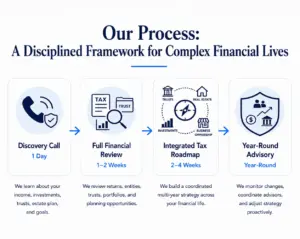
We don’t have a standard process for High-Net-Worth (HNW) clients because no two HNW situations are the same. What we do have is a disciplined framework for understanding your full financial picture before we make a single recommendation.
Step 1: Discovery Call (1 Day)
A confidential, free conversation to understand your income sources, investment portfolio, real estate holdings, trust structures, estate plan, and forward-looking financial goals. We ask the questions most advisors skip: Is your estate plan coordinated with your current tax strategy? Who on your advisory team is looking at all of this together? What’s the next major financial event on the horizon?
Step 2: Full Financial Review (1-2 Weeks)
A comprehensive review of your prior returns, entity structures, investment portfolio, trust documents, estate plan, and financial objectives, all at once. This is where we identify what’s been missed, what’s in conflict, and where the most significant planning opportunities exist.
Step 3: Integrated Tax Roadmap (2–4 Weeks)
We build a custom, multi-year tax strategy that is integrated, coordinated across your full advisory team, and documented for defensibility. Every element of your financial life is considered in relation to every other. Nothing is planned in isolation.
Step 4: Year-Round Advisory
From here, we stay engaged throughout the year, monitoring your tax position in real time, coordinating with your investment advisors and estate attorneys, and making adjustments as your financial life evolves. This is not a once-a-year relationship. It’s an ongoing advisory practice.
Why High-Net-Worth Clients Choose Gildark Financial
 We’re Built for Complexity.
 We’re Built for Complexity.
Our team handles the full range of HNW tax complexity, from multi-source income and equity compensation to trust taxation, international reporting, and estate coordination. This isn’t a stretch for us. It’s what we do daily.
We’re Local and We Know California.
 We’re Local and We Know California.
San Diego’s high-net-worth community has unique characteristics — significant biotech and defense industry equity, coastal real estate, cross-border business activity, and a large population of former California residents still carrying California tax exposure. We know this terrain intimately.
We Represent You, Not Just Prepare Your Return.
 We Represent You, Not Just Prepare Your Return.
Our Enrolled Agents have unlimited representation rights before the IRS. At the HNW level, where returns are more likely to attract scrutiny, having a professional who can stand in front of an examiner and defend your return is not optional, it’s essential.
We Coordinate Across Your Full Advisory Team.
 We Coordinate Across Your Full Advisory Team.
The best outcomes for HNW clients come from advisors who work together. We operate as a collaborative partner to your investment manager, estate attorney, and financial planner, filling the tax and accounting role in a way that reinforces the rest of your financial plan.
You Work With Professionals Who Know Your Name.
 You Work With Professionals Who Know Your Name.
At a certain level of wealth, you’ve earned the right to work with a team that knows your situation deeply and responds to you directly. No rotating associates, no offshore call centers, no disappearing acts between February and October. We’re here year round, because taxes aren’t seasonal to us.
Call us now
The solutions, insights, and guidance you need to achieve your financial goals are at your fingertips — but you have to make the call. Contact us online or call our office today to explore our full range of services with a knowledgeable financial professional.
Frequently Asked Questions
At what level of income or wealth does specialized HNW tax planning start to make sense?
As a general rule, once you have more than one significant source of income, meaningful investable assets, business ownership, or real estate; this is especially important if your income places you in the top federal and California brackets. The difference between standard and specialized tax advice becomes measurable in tens of thousands, if not hundreds of thousands of dollars..
Can you work with my estate attorney and financial planner?
Yes, and this is exactly how we prefer to work. The most effective HNW tax strategies are those that are fully integrated with your estate plan and investment approach. We operate as a collaborative partner to your full advisory team.
How does California’s lack of a capital gains preference affect my planning?
Significantly. While federal long-term capital gains rates top out at 20% (plus 3.8% NIIT for high earners), California taxes all capital gains as ordinary income at rates up to 13.3%. This makes deferral strategies like 1031 exchanges, opportunity zone investments, installment sales, and charitable vehicles especially valuable for California HNW taxpayers.
What is the NIIT and how does it affect high-net-worth individuals?
The Net Investment Income Tax is a 3.8% federal surtax on investment income for individuals with modified adjusted gross income above $200,000 single or $250,000 married filing jointly. For HNW individuals, this tax is almost always in play and is a core consideration in investment structuring and income planning.
Do you handle returns for clients with foreign assets or international income?
Yes. We have extensive experience with FBAR filing, FATCA compliance, Form 8938 reporting, foreign tax credits, and the treatment of foreign source income for U.S. residents.
How do you price services for HNW clients?
Pricing for HNW engagements is based on the scope and complexity of the work, not a standardized flat fee that ignores the reality of your situation. We provide a clear, transparent scope and fee structure before any engagement begins.

 619-736-3044
 Email Us
 1597 N Johnson Ave, El Cajon CA 92020